

Sizewell C
Wetland Habitat Creation
Location
Suffolk
Time Period
Bronze Age,
Iron Age,
Medieval,
Mesolithic,
Roman,
Saxon,
Client
EDF,
Minsmere was a tidal saltmarsh that would have been an important resource for hunting and foraging, livestock grazing and salt manufacture from the prehistoric period onwards. Much of the archaeology reflects this, as well as showing the attempts of landowners from the medieval period onwards to drain and define its limits by digging ditches. In addition, the marsh could be a place of spiritual retreat. Leiston Abbey was founded not far to the east of the site in 1183, a location then well within the marsh, but in 1363 it was re-sited to a drier location to the south-west.
Prehistory
The fringes of the marsh were probably visited by hunter gathers during the Mesolithic (c. 10,000–c. 4000 BC) but it was not until the ‘Beaker’ period (c. 2600–c. 1800 BC) that there is clear evidence for some kind of occupation. This takes the form of small groups of pits across the landscape, some containing Beaker pottery. This mainly red-coloured pottery is characterised by its distinctive forms and decoration, and though it is found in all parts of the country, the pottery is particularly abundant in East Anglia — perhaps because our North Sea coastline provided one of the first landing places for European ‘Beaker’ migrants. One theory is that the pits and the finds might be remains from temporary camps next to the marsh, occupied during periods of hunting.
Image: a rare beaker pottery cup with ‘barbed wire’ pattern


In the Iron Age it is likely that thin settlement and pastoral farming bordered the marsh. Two potential roundhouses have been found and waterholes were dug for livestock. One waterhole was wood-lined and included was a fragment of a wooden axle from a chariot or cart that had been reused as a stake. The axle has been radiocarbon dated to the Middle Iron Age (c. 400–c. 100 BC).
Image: the waterlogged pit in which the axle was found
Roman
The East Anglian coast and tidal marsh was important for salt production in the Roman period. The excavations have uncovered the remains of a saltern of the period, in the form of a large pit that was scorched red by burning and which contained fragments of briquetage. These ceramic fragments come from the flat-bottomed basins in which the brackish water was heated, and one piece is covered with what may be a vitrified salt glaze. A Roman small town at Hacheston lies c. 10 miles to the south-west of the site, one of Suffolk’s larger settlements at this period. We hope that the excavations will provide further evidence for the Roman use of the hinterland between its towns and coast.
Image: Roman saltern pit, scorched red by burning


Medieval
A small number of Anglo-Saxon buildings have so far been identified in Area D, which again would have bordered the marsh. They are all ‘sunken featured buildings’ (c. AD 410–c. 800) that survive only as a large pit, over which a wooden floor might have been suspended, and they typically had a standing post at each end to support a pitched roof. These buildings are generally thought to have been used for craft or industrial activities, with the community living in larger, nearby post-built halls (which have not been found). Finds of the period include spindle whorls , evidence for wool yarn production.
The most prominent features found have been the many ditches and enclosures that cross the site. The majority of these probably date from the later medieval period (AD 1066–1539), and some were frequently recut, reflecting the use of the landscape for penning livestock, as well as an ongoing need to drain the marshy bounds. It is likely that the landscape was a mix of common and privately held land, including some in the ownership of Leiston Abbey.
Image: recording of an Anglo-Saxon sunken-featured building
Finds

Ipswich trade token of copper alloy dated 1651. Issued by grocer Samuel Stannard.

Spindle whorl found in an Anglo-Saxon building (c. AD 410–c.800) in Area D. It would have had a wooden spindle shaft (about the thickness of a pencil). Spindles were used for spinning strands of wool prior to weaving.
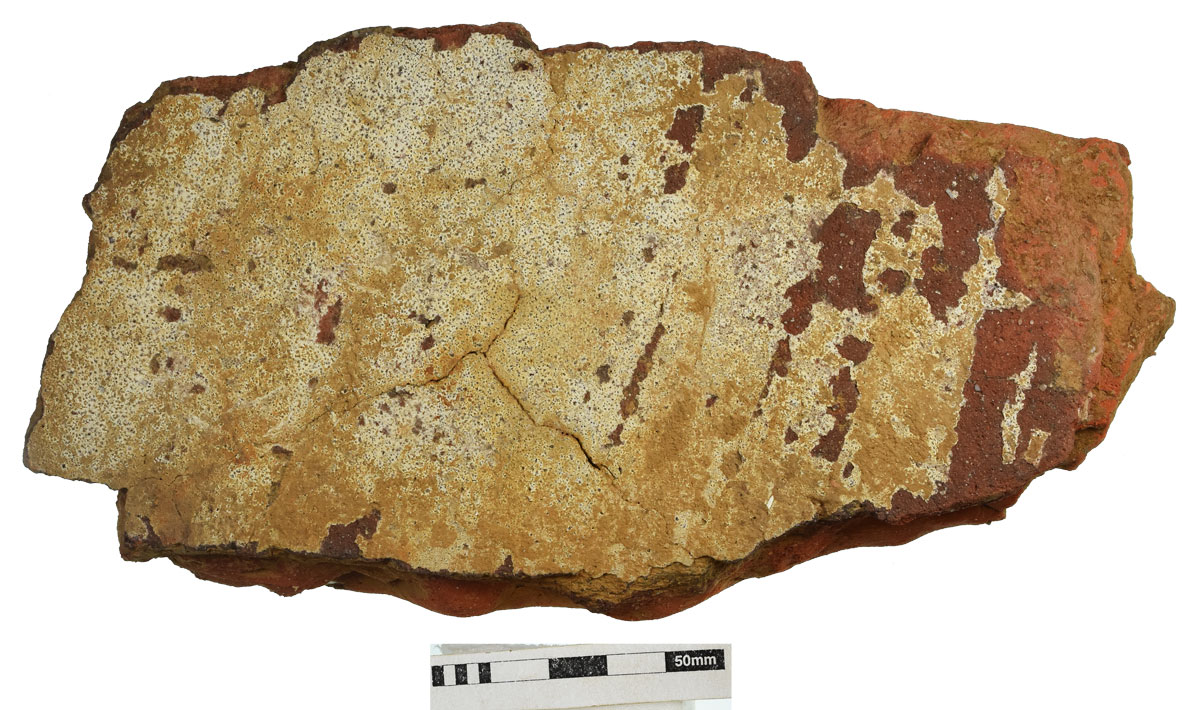
Briquetage fragments from Roman ceramic basins used for salt production
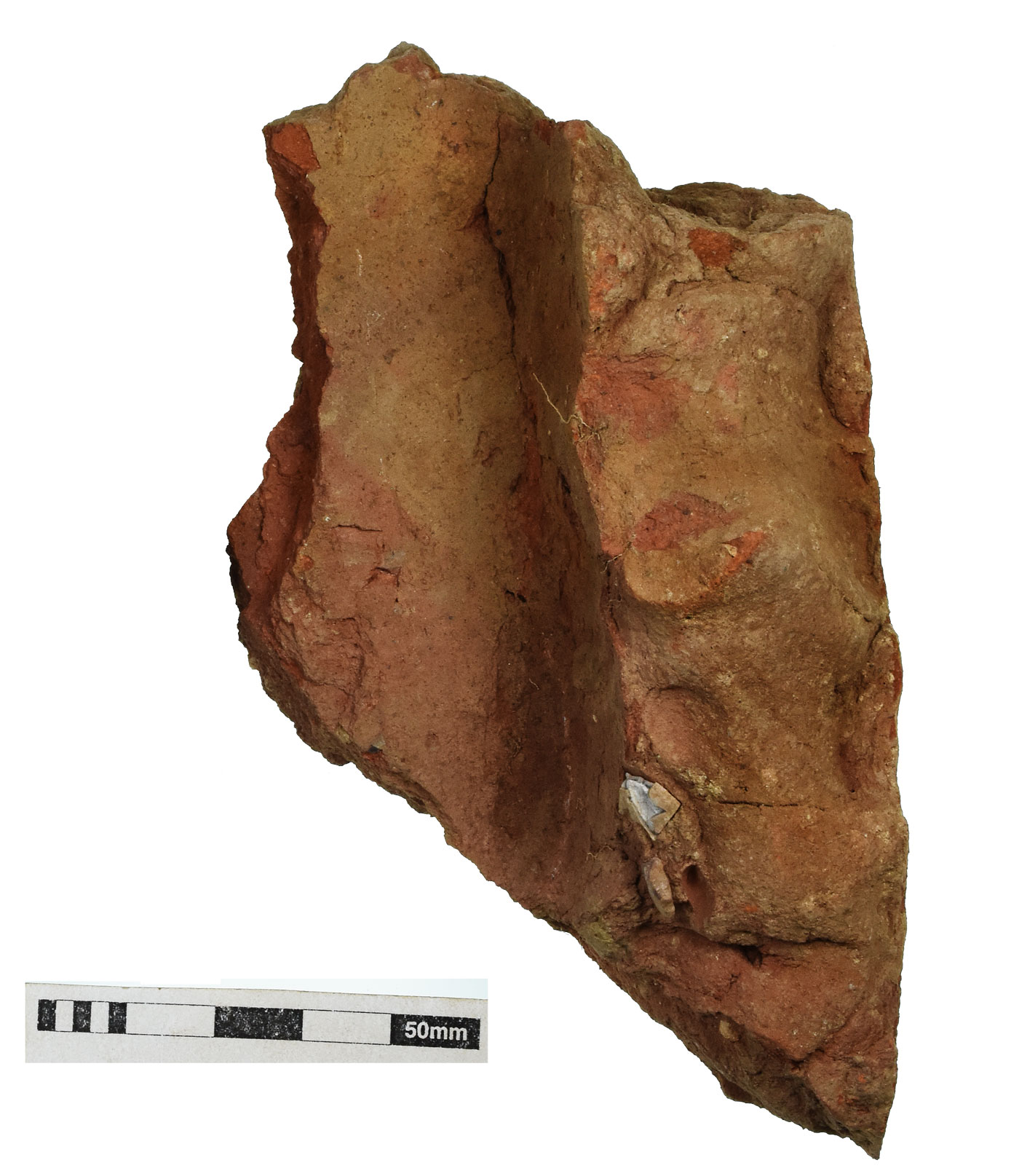
Briquetage fragments from Roman ceramic basins used for salt production