

Sizewell C
Sizewell Link Road, Middleton
Start Date
March 2025 - Ongoing
Location
Suffolk
Time Period
Anglo-Saxon,
Iron Age,
Roman,
Client
EDF,
The central part of the Sizewell Link Road (SLR) is located near the modern-day village of Middleton. As the route travels eastwards, the archaeology becomes denser and marked by some truly remarkable discoveries. Oxford Cotswold Archaeology archaeologists have been working to the south of the village, uncovering the secrets of its surrounding fields. Evidence of prehistoric structures, Roman industry and Anglo-Saxon cemeteries has reshaped our understanding of how earlier communities used this coastal landscape.
Ladder
Among the most remarkable finds was a prehistoric ladder, preserved with two of its original rungs intact. The ladder descends into a watering hole where measures had been taken to shore up the sides, providing support and preventing silt from contaminating the water source. Such discoveries are exceptionally rare because prehistoric ladders were more commonly created by cutting steps into a single log.
This example was constructed with oak rails, chosen for strength and durability, while the rungs are still undergoing species identification. The rails bear clear woodworking marks, including stop marks where an axe blade struck and lodged in the timber, leaving distinct impressions. Specialists have confirmed that the tool used was a flat axe.
Image: the excavation team preparing the ladder to lift


Kiln
Roman industry is a defining characteristic of this part of the route. A pottery kiln was discovered in exceptional condition. It is a type known as a horizontal draught kiln, which used two flues simultaneously to generate airflow and distribute heat. Remarkably, one of the flues was fully intact and the linings of the inner walls were beautifully preserved.
The team recovered high-quality pottery sherds, now with specialists for dating. Although no pots remained in situ, material associated with the kiln, such as broken plates and bar fragments, had been dumped back inside after it fell out of use.
Image: excavation team staring down the flue of the Roman pottery kiln
Corn dryer
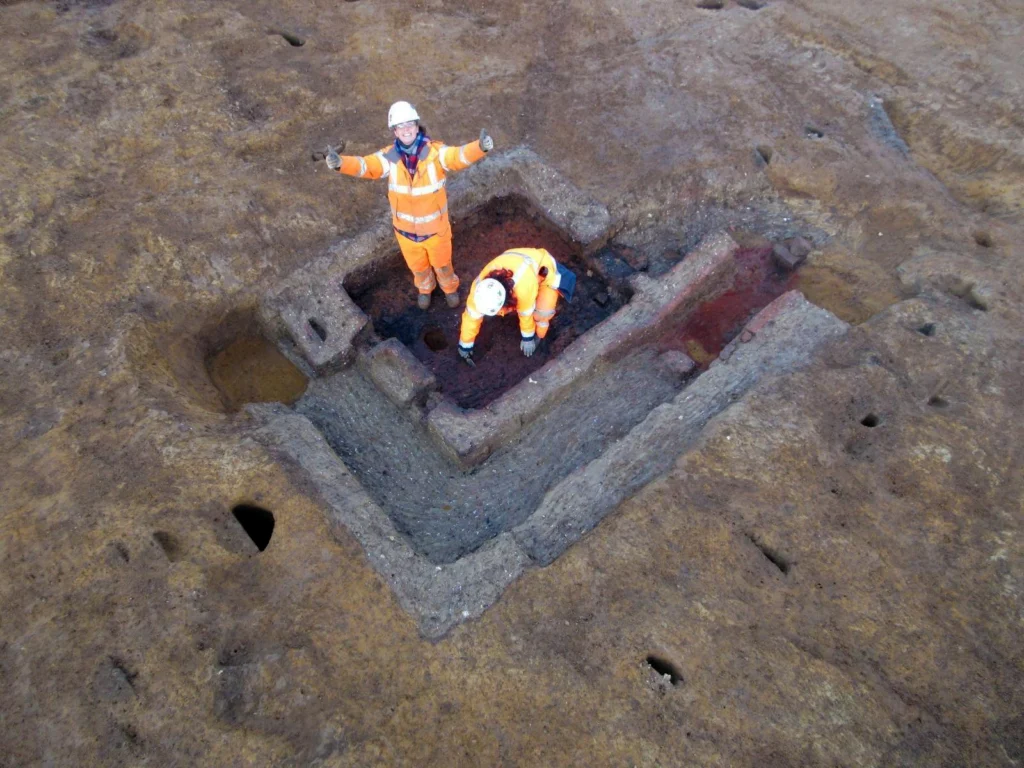
The corn dryer is an unusual maze-shaped example, differing from the more typical T-shaped design. It consisted of a central chamber with a looping flue that curved around and re-entered the structure, with a series of branching corridors to help distribute heat.
Excavation revealed an earlier construction phase in which the flue had been slightly repositioned, as well as two successive floor surfaces. A ring of surrounding postholes indicates that the dryer originally had a supporting structure.
Eventually, the corn dryer fell out of use, after which it appears to have been deliberately levelled and later built over. The area was reoccupied and continued to hold importance for the people living and working there. Together, these features build a distinct picture of the industrial activity undertaken by the Romans in this landscape.
Image: the team excavating the corn dryer
Cemetery
Further along the projected route and further forward in time, exciting Anglo-Saxon discoveries have shed new light on the scale and practices of the communities in this area. A cemetery containing more than 140 graves has been carefully excavated near the village of Middleton. Artefacts recovered include iron spears and blades, buckles and beads.
Many graves are aligned east–west and respect one another’s placement, suggesting a carefully planned and organised layout. Although no grave markers survived, the cemetery clearly held significance. Despite the impressive finds, the burials appear to represent a low-status community, and current dating places the cemetery in the 7th century.
A posthole building was identified immediately south of the graves. Its function remains uncertain because no dating evidence has yet been recovered. It may have been associated with the cemetery, or its placement may be coincidental, adding a tantalising mystery to the site.