

Sizewell C
North of Lovers Lane
Start Date
March 2023 - December 2023
Location
Suffolk
Time Period
Neolithic,
Saxon,
Client
EDF,
Early Neolithic
The North of Lovers Lane site at Sizewell has produced significant evidence for occupation early in the Neolithic period. More than 1300 pottery sherds have been found that are mostly of types known as ‘Carinated Bowl’ and ‘Plain Bowl’ wares, dating between 3900–3700 BC, and representing some of the earliest pottery found in this country. Several thousand worked flints have also been recovered including blades, knives, scrapers and arrowheads.
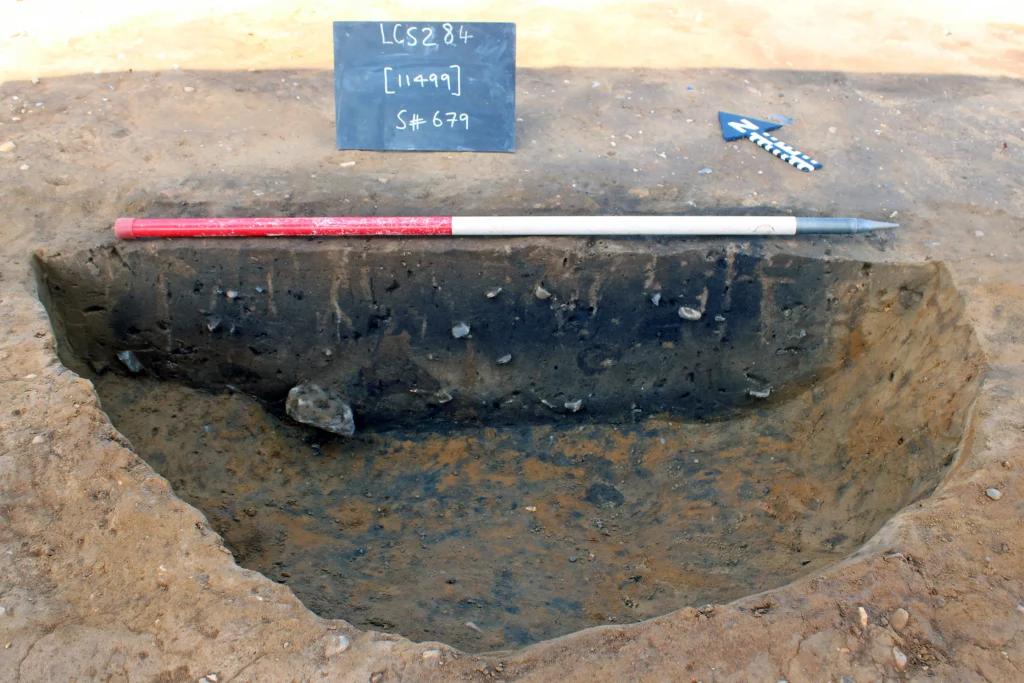
The pottery was found in 200–300 Early Neolithic pits, dating from 4000–3000 BC. The pits were in all sizes, but the majority measured an average of 1m in diameter and 0.40m deep. Organic waste including animal bone might also have been included in the pits originally, but this has not survived (bone decays quickly in the acidic, sandy soils at Sizewell). Instead the pit fills included layers of dark, organic character.
Image: finger-fluted ‘Carinated’ pottery

The pits were spread across the whole excavation area, both dispersed in loose scatters and in small clusters, with a concentration on higher ground along the northern edge.
The purpose of such pits has been under debate for many decades and it is hoped that the discoveries at Sizewell will be able to add greatly to these discussions.
Image: a typical Early Neolithic pit that has been half-sectioned
Middle Anglo-Saxon
Much later, a new phase of occupation at the site started in the late 7th century AD, the Middle Anglo-Saxon period, marking the beginning of 700 years of continuous medieval settlement in the area.
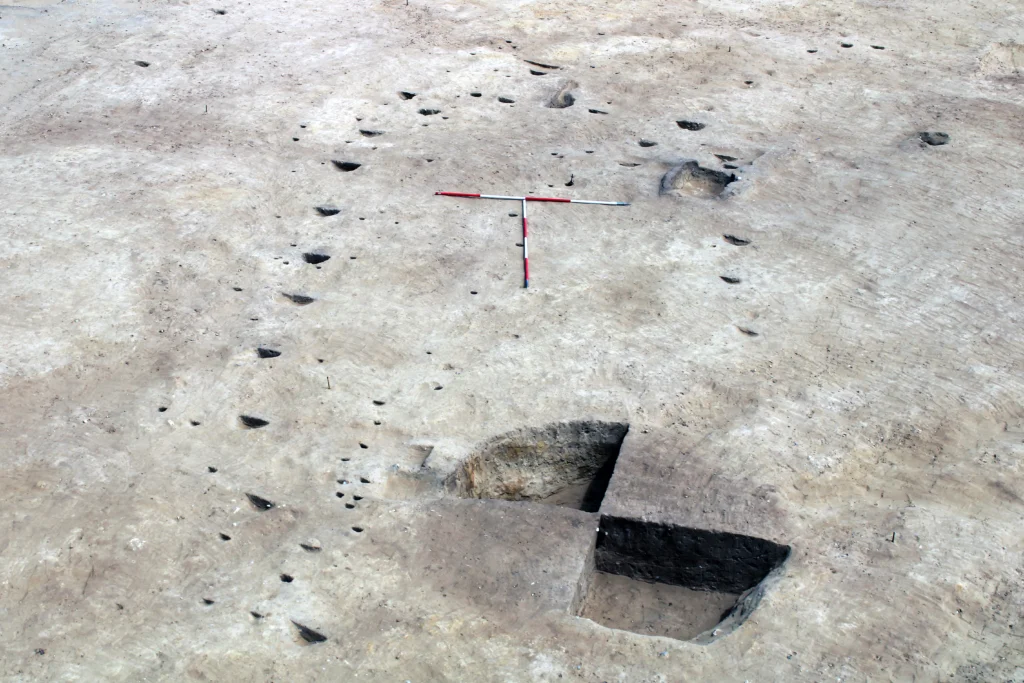
The main feature from this period was a ditch enclosing an area of 3,800m2 (half the size of a football pitch). There were two structures within it. One was a post-built ‘hall’ in the north that was close to a wide, fenced and gated entranceway. The second was a large sunken-featured building (‘SFB’) in the south-east that followed the alignment of the ‘hall’.
Image: posthole building or ‘hall’
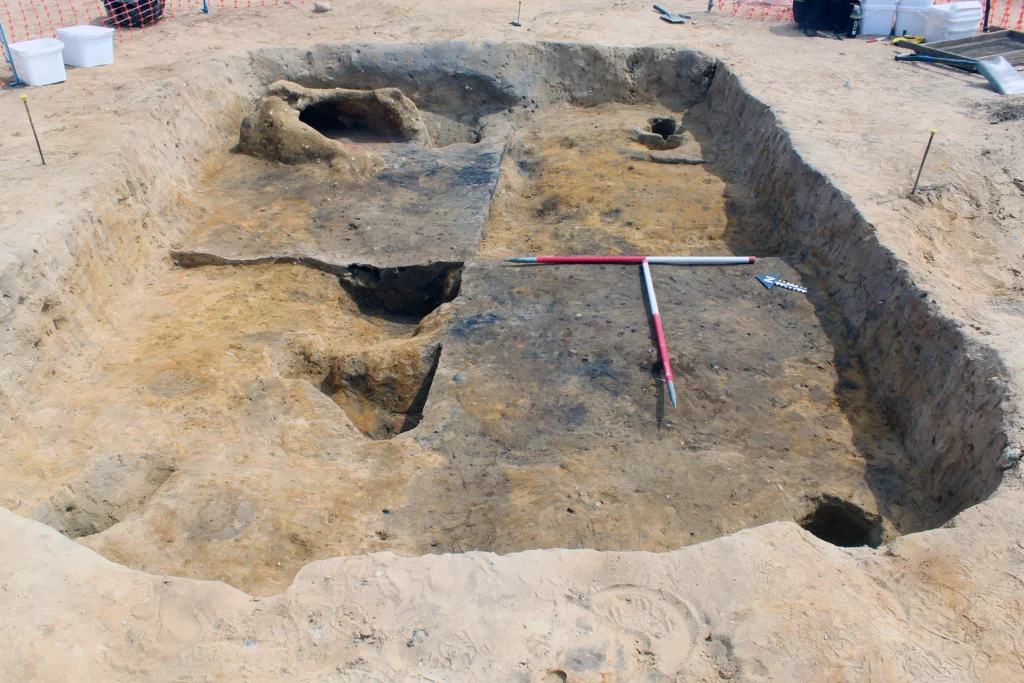
The SFB consisted of a shallow, rectangular pit with a flat base and postholes, for posts that would have supported a superstructure. Anglo-Saxon SFBs (also known as Grubenhäuser or ‘pit houses’) are thought to have been used as workshops for craft working, such as weaving. They may have had a plank floor that was suspended over the pit. However, it appears that, after the floor of the Sizewell example was removed, a small oven was built into the north-eastern corner of the pit.
The clay-built oven was partly formed around a standing wooden corner post (the form of which remained as a void, the post having decayed). This implies that at least part of the structure had been upstanding by this time, though it is not clear whether the building was still in use or had been abandoned. This example of re-purposing is something very rarely seen in an SFB, therefore, precise dating of the building’s use, its disuse and re-use will be crucial to our understanding of what was happening at that time.
Image: the SFB excavated at Sizewell