
Rare funeral pyre discovered at Sizewell C
Date Written
22 April 2026
Author
Chris Fern (PX Project Manager) and Ed Tolley Ed Tolley (Goose Hill Area Lead)
Projects

The remains of a pyre were recently discovered at our Goose Hill site, within the Sizewell C archaeological works. A pyre is a structure usually of wood used to burn a body in a cremation rite. It was located on a slope with a commanding view looking south towards what is today the coastline. Unfortunately, the feature had suffered disturbance during World War II when the site was used as a training ground, but it remains a rare and important find.
The pyre was probably built of a stacked lattice of timbers (c. 3m x 2m in plan), to a height of perhaps a metre-and-a-half, with a core of kindling and heath scrub. This lattice would have formed a platform upon which the body of the deceased was laid. The whole structure would also have been supported by standing posts arranged around its edges. At the funeral the pyre would have been lit to cremate the dead person. The rite of cremation was practised by human societies throughout the past, including in prehistoric, Roman and Early Anglo-Saxon periods.
Image: the pyre, pre-excavation, strung up for grid excavation and sampling

The remains at Goose Hill comprised a roughly rectangular spread of dark soil, blackened by charcoal, with occasional pieces of burnt bone. The recovered bone fragments will be analysed to confirm they are human, and for what they might tell us about the sex and age of the individual, as well as any pathologies. Amidst the charcoal-rich soil were patches of sandy ground, that had turned pink from burning. Up to six postholes (for standing posts) were recorded around the pyre, with three along one side and the others at the short ends; there were no postholes along the other long edge.
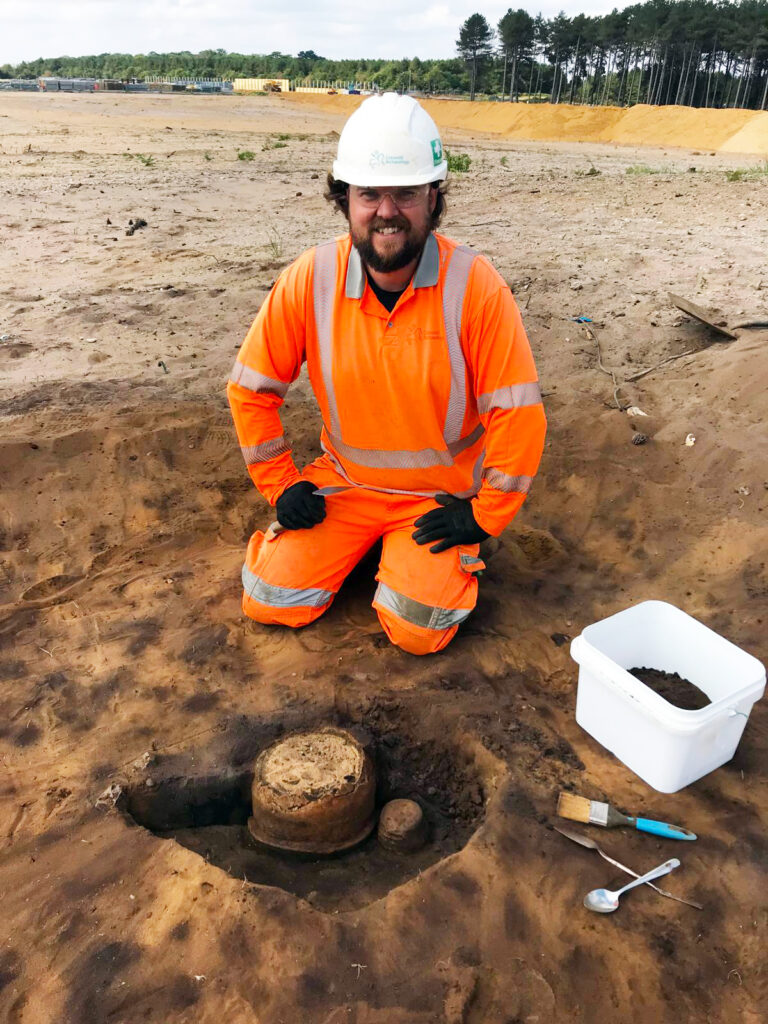
Given the scarcity of bone it is possible that the majority of the remains were removed after the cremation act, probably for burial in a pottery urn elsewhere. However, burials across the Goose Hill site were rare. There was a single cremation burial dating to the Bronze Age in a Collared Urn (c. 1950 – 1600 BC), and one other possible urned cremation.
Pyres do not usually survive in the archaeological record, because as surface features, they are vulnerable to ploughing and other disturbances. For our pyre, we think it was probably preserved by a covering mound (since lost to ploughing), as the pyre was located off-center within a ring ditch.
Image: Will (Archaeologist) with the Collared urn found on site.
It is currently unknown if the surrounding ring ditch was contemporary, or if the pyre had been inserted into the edge of an existing barrow. There was no central burial within the ring ditch, as is common with these types of features, but this might have been destroyed by a later ditch that had cut through the center of the mound.
While the date of the ring ditch is currently uncertain, it must date before the Iron Age (c. 700 BC – AD 43), since an Iron Age pit had cut the edge of its already infilled ditch. Within the later ditch a polished flint axe from the Early Neolithic period was recovered, though this axe was probably residual (meaning it had been around a long time before it was ultimately buried)
Image: Leo (Field Supervisor) with a Neolithic polished axe found within the ring ditch


The date of the pyre is currently uncertain. As we find out more, it may be possible in the future to submit samples of bone and charcoal for radiocarbon dating. We also plan to undertake a study of the charcoal and burnt plant remains, as well as studying any objects placed on the pyre with the deceased. We want to establish as much as possible about the ritual, from the status of the individual to the fuel used and the local environment at the time.
Image: the location of finds and samples being accurately recorded
The ritual of cremation was practised by human societies throughout the past, including in prehistoric, Roman and Early Anglo-Saxon periods. An Anglo-Saxon pyre was found at a cemetery approximately 8km south-west at Snape, but there was a lack of activity at Goose Hill around this date. More likely, our pyre will prove to be prehistoric in date, perhaps of the Bronze Age or Iron Age.
