
A Bronze Age barrow discovered once again

One of the earliest features uncovered at the Two Village Bypass (TVB) site was the remains of a possible Bronze Age round barrow (c. 2400–700 BC). Excavated in advance of the proposed Sizewell C development, the TVB lies on a gentle, south-facing slope bordered by three converging valleys. In this elevated position, the barrow would have stood prominently, overlooking the surrounding landscape. A deliberate placement common in the Bronze Age, where barrows were often built to command wide views and serve as lasting landmarks.

Although the barrow’s mound has long since disappeared, the circular ditch that once encompassed it was discovered during the excavation. A rectangular pit was also found near the centre of the barrow, which may have been some form of chamber situated beneath the mound.
Inside this pit were dark mineralised layers, perhaps the remnants of the chamber’s wooden lining, including a floor and roof; since the chamber had been dug into the site’s loose sandy soil, this lining will have prevented the sides of the pit from collapsing. Sandwiched between the mineralised layers of the floor and roof was a thin band of very fine sand. This had probably entered the chamber when then wooden lining was still intact, as the fine sand particles will have been small enough to pass between the gaps of the lining to fill the chamber.

There was no evidence of a burial or any other deposit within the chamber. It is possible that the site’s acidic, sandy soils gradually dissolved any skeletal remains. However, on sandy sites like this, tooth enamel typically survives, but no enamel was found in the chamber either.
In addition, the way in which the chamber’s wooden roof had eventually collapsed down onto its floor provided indirect evidence that it would have been empty when this event happened; had there been something or someone within the chamber, then the mineralised remains of the fallen roof would have appeared distorted where they lay over it.
Instead, the roof was found in a horizontal position just a few centimetres above the remains of the wooden floor, separated only by that thin layer of sandy dust, meaning there had been nothing substantial between the two when this event happened (the wooden structure would have collapsed long before the acidic soil had time to dissolve any bones).
The wood-lined chamber may never have been intended for use as a grave, or it might have acted as a cenotaph. Alternatively, the burial may have been removed later, but before the chamber collapsed. It is also possible that the remains of the deceased were buried within the overlying mound.
Image: dark staining caused by wood within the barrow chamber

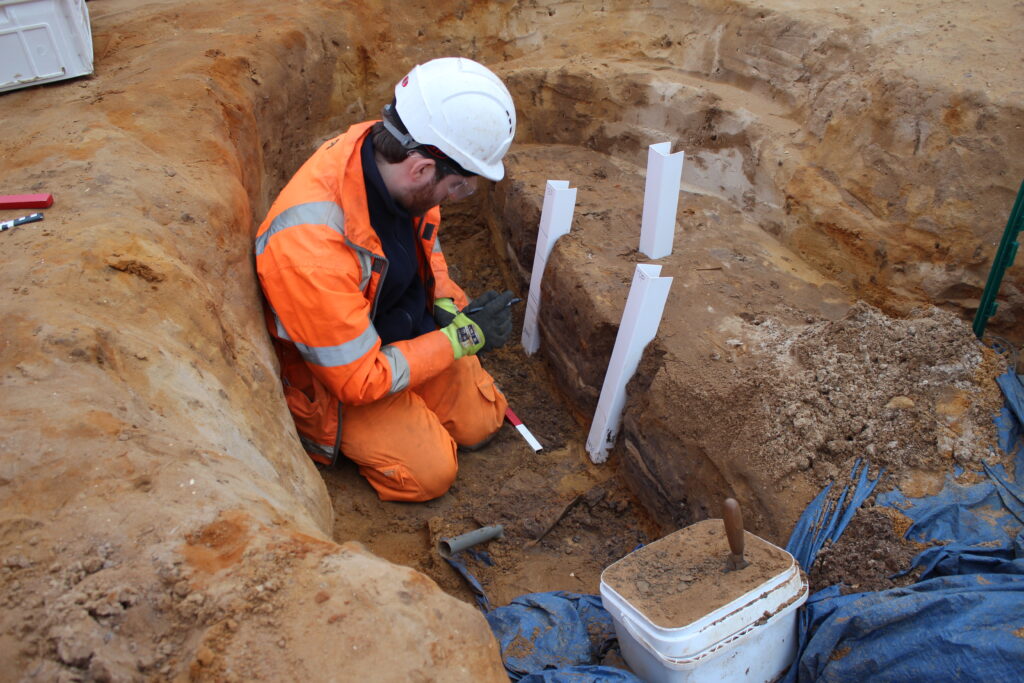
Although the mound itself did not survive until our excavations, the chamber collapsed while the mound was still present. The soil that formed the mound sank into the newly created cavity, and this material has survived to the present day.
This revealed that the mound was primarily composed of soil rather than sand and gravel, indicating that it was not constructed from spoil heaped up from the excavation of the surrounding ditch. The ditch itself was quite small and would not have provided enough material for the mound. Instead, it is likely that the area around the barrow was de-turfed, providing the soil used to build the mound.
Image: OCA archaeologist takes column samples through the deposits in the chamber
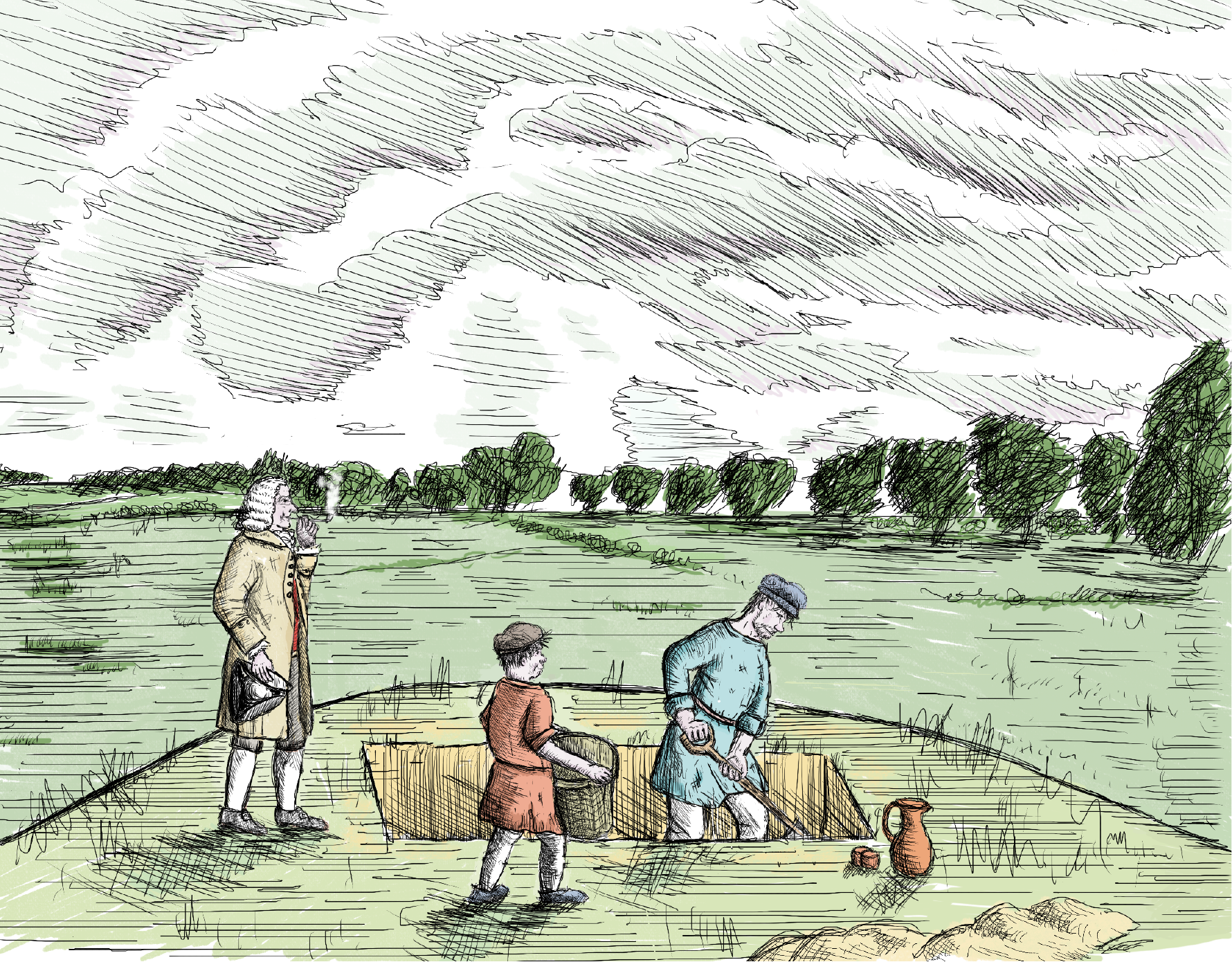
In the 17th or 18th century someone dug a large pit down into the mound, perhaps attempting to investigate or loot its contents. Their pit was located right in the centre of the barrow. Given that the small ring ditch encircling the barrow had long since disappeared from the landscape by this time (having become filled up with soil over time), the only way someone could have targeted the exact centre of the barrow is if the mound itself was still surviving.
They must have dug a shaft straight down through the centre of the mound into the underlying ground hoping to find something, fortunately giving up before they got down far enough to destroy all the remains of the chamber. The backfill in their shaft contained a near-complete jug and a piece of tobacco pipe.
Image: the near complete jug in the backfill of the antiquarians shaft

This pit was dug into the mound at a time when people in Britain started to seriously explore ancient earthworks and mounds, such as William Stukeley and Thomas Browne. It is possible that this was an attempt by an antiquarian to investigate the mound, although it may simply have been an example of looting or treasure hunting.
We have also found that the mound had influenced the use of land for thousands of years after its creation. Around the barrow were several long, narrow ditches, which formed the boundaries of a rectilinear field system. Several of these ditches ran up to and stopped short of the barrow, indicating that it was still clearly visible above ground when they were created. Although the date of this field system is not yet fully understood, some of it appears to have been medieval.
The barrow’s mound was destroyed and ploughed away sometime between the 17th century investigations and the late Victorian period, by which time it no longer appeared on maps. This marked the end of the barrow’s presence in the landscape, which had lasted for approximately 3,000 years—an aspect of Stratford St Andrew’s history that we are now uncovering again!