
A rare Byzantine pilgrim souvenir found at Sizewell C
Date Written
17 April 2025
Author
Rachel Tyson (Glass Specialist) and Natasha Dodwell (Senior Finds Manager)
Projects
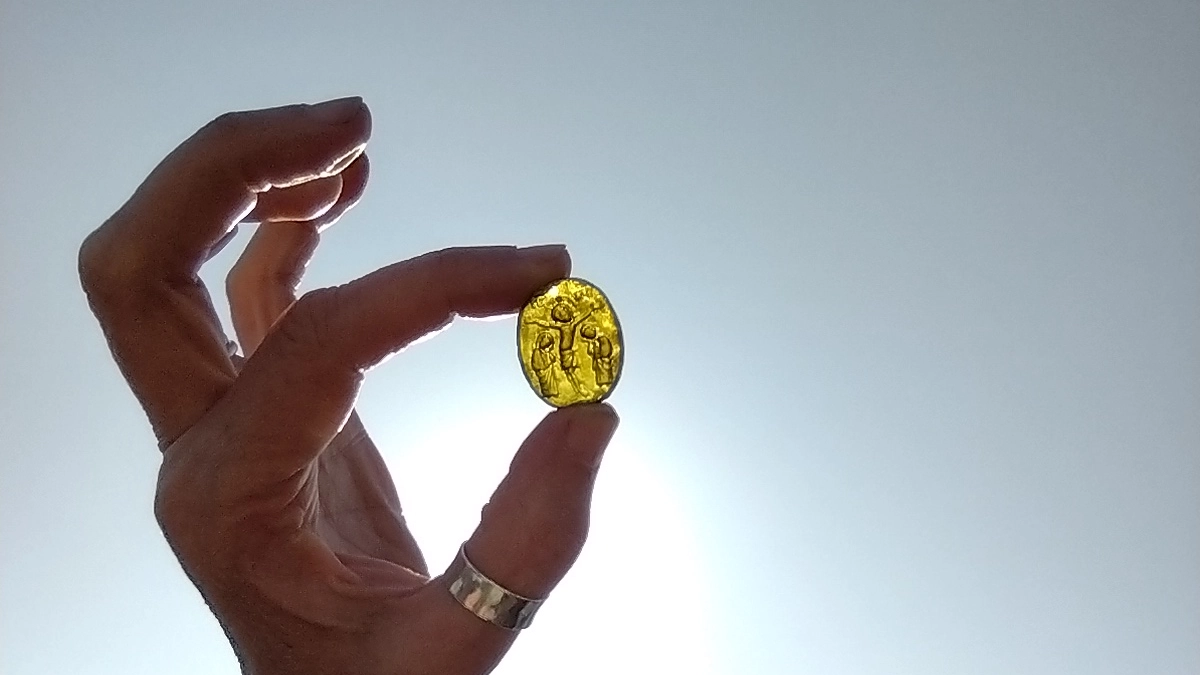
This amazing green glass ‘cameo’ was brilliantly spotted in topsoil during excavation near Leiston, Suffolk, in advance of the planned Sizewell C development. The object is only c. 26mm in height but has a beautiful moulded decoration showing Christ’s Crucifixion, with St Mary and St John on either side of Jesus. The letters above read IC and XC, from Greek letters that form the Christogram for ‘Jesus Christ’ – common on Christian icons.

Cameos like these were likely made as pilgrim souvenirs or holy medals, and are thought to have originally been produced in Byzantium during the 11th and 12th centuries. A very similar example to the one found at Sizewell can be seen in the British Museum’s collection—that one is made of opaque red glass. By the 13th century, such cameos were being produced in Venice (where many examples have been found), although it’s unclear whether they were made using moulds brought from Byzantium or if entirely new moulds were created. Byzantine culture flourished in Venice, where the Greek Orthodox and Roman Latin worlds came together.

Although the colour of the glass cameo is a stunning green when held up to the light, the carefully bevelled edges on the reverse suggest that it was originally mounted, perhaps as an inset to a ring or necklace. Set like this, the glass with its moulded image of the Crucifixion would appear much darker and quite sombre.
Image: a scene of the Crucifixion is moulded on the surface, with St Mary and St John at Christ’s side
The Sizewell cameo is a rare and exciting archaeological find in Britain. Although over 200 of these glass cameos are known across Europe and beyond, from 60 different mould designs, they are largely in museum collections and devoid of context.
This cameo was uncovered only recently, so further analysis is planned to be carried out on the piece to help build a fuller understanding. However, at this stage, it’s hard to overlook the fact that it was discovered close to Leiston Abbey. It seems likely that the glass cameo was lost by someone associated with or visiting the abbey—perhaps as a pilgrim souvenir or a devotional piece of jewellery.
Further reading:
Buckton, D, 1994 Byzantium: Treasures of Byzantine Art and Culture, British Museum