
Stepping into the past: Prehistoric ladders and wooden structures uncovered at Sizewell C
Date Written
21 January 2026
Author
Liberty Goldspink (Assistant Supervisor) and Hannah Pighills (Finds Supervisor)
Projects

During excavations at Sizewell C in Suffolk, our dedicated Oxford Cotswold Archaeology (OCA) field team unearthed rare wooden artefacts that shed new light on how prehistoric communities lived and used this landscape. Still resting in situ, a ladder leading down into a watering hole has been dated by our specialists to the Iron Age. The superb preservation of the wood is echoed by another wooden structure discovered on Goose Hill, the purpose of which remains a mystery.
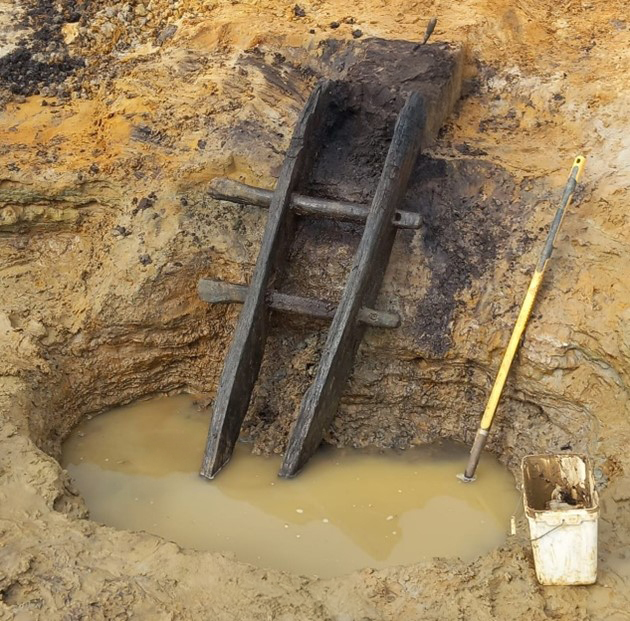
A Prehistoric ladder

The ladder is a remarkable find, being complete with two of its original rungs still in place. This is particularly rare, as more often prehistoric ladders are created by chopping steps into a large log. The rails are made of oak, an ideal strong and durable material, while the rungs are currently awaiting species analysis. The rails display clear evidence of woodworking: stop marks are visible where an axe blade became lodged in the wood, leaving distinct indentations. Our specialists believe that the blade marks would have been made by a flat axe.
The ladder’s construction demonstrates careful craftmanship. The left end of each rung is slightly wider than the mortise it fits into, which helps locks it in place, while the right end features a peg hole that would have held a wooden peg for added stability. Incredibly, the second rung still has its original peg intact.
During the excavation process, our OCA archaeologists discovered that wattle was present on the side of the watering hole. This shoring technique was used to provide support for the sides of the watering hole and help to prevent silt from contaminating the water source.

Kieran Stemp, who skilfully worked on this feature, said:
“Excavating wooden archaeology can be a delicate task and very time consuming, especially when in waterlogged conditions, so it’s important to protect artefacts by ensuring the conditions you found it in can be reapplied between and after using a trowel to sustain preservation until it can be safely removed, and sent away for specialist storage or restoration.”
The level of preservation of the wood relies on various factors: for the wood to survive to this extent, the pH of the soil must be suitable and within anaerobic conditions, meaning the wood must be fully charred or waterlogged.
Image: archaeologists Jess (left) and Kieran (right) on site with the ladder
A wooden structure
Near the coastline at Goose Hill, our team has excavated an unusual wooden structure embedded within a peat layer, but its purpose and function remain under investigation. It was constructed using a variety of timbers, including split oak planks and a large oak roundwood. The oak shows signs of a woodworm infestation which reveals that the wood was dead and possibly exposed to the elements for a long period before being worked into this structure.
Image: Senior Project Officer Lizzy inspects the structure

Video: 3D model of the wooden structure revealed during excavations at Sizewell C
The structure is in close proximity to a possible burnt mound, which itself is an enigmatic feature, often composed of heat-affected stones and charcoal. These mounds frequently have associated pits or wooden structures, which we believe our structure may represent, most likely used to contain water. Several theories have been proposed to explain their function, ranging from use as a trough, to cooking, or even as an ancient sauna. Our specialists are in the process of dating the wood using techniques such as radiocarbon dating. Environmental samples of the peat in which the structure was preserved will also help determine the date of this unusual piece of woodworking.
Assistant Supervisor Eirlys Walker said that:
“It was a great opportunity to work on such an unusual feature and collaborate with the specialists to learn new excavation techniques we don’t typically get to use.”
Image: Assistant Supervisor Eirlys on site with some of the recovered wood finds

These unique finds are among the many examples of excellent archaeology the OCA field team has uncovered in Leiston and the surrounding area in preparation for the construction of the new nuclear station, Sizewell C. The longevity of the oak and wooden artefacts reflects the long history of human activity along this part of the Suffolk coastline.