
Shedding light on Sizewell C’s worked stone: From the everyday to the ecclesiastical
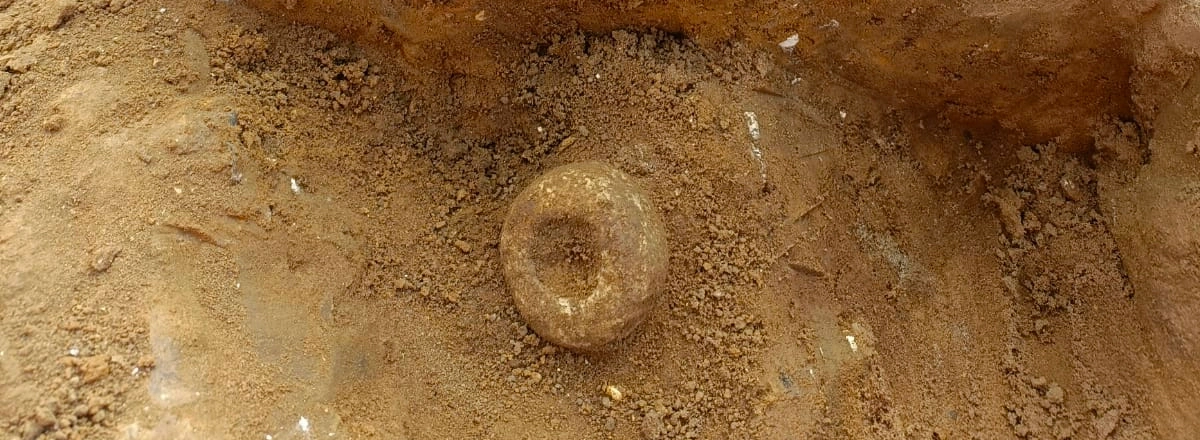
At first glance, the worked stone from Sizewell C might not seem particularly exciting, but a closer look at some of the more unusual finds tells a fascinating story about life in the medieval period. From a rare stone lamp to a hefty mortar, and from spinning tools to whetstones imported from Norway, these artefacts hint at both everyday rural activities and possible connections to Leiston Abbey.
Stone lamp
Perhaps the most unusual stone object is a square lamp (usually referred to as a ‘cresset’) from the Main Development Site (MDS). This is made of Caen stone, which was imported from France and usually used as a building stone. Several small, neat ashlar blocks of Caen stone were found at the same site. These blocks are of regular sizes that perfectly match the stone cresset, suggesting that the lamp was carved from a surplus block of ashlar. Caen stone mainly features in ecclesiastical buildings and fortifications while Lincolnshire Limestone was also favoured in church buildings, so an ecclesiastical origin for the ashlar seems likely.
Stone cressets are considerably less common finds than ceramic ones, and even large-scale urban excavations will rarely generate more than one or two examples. This lamp was probably used in a workshop rather than in a domestic setting, but more elaborate stone lamps are usually associated with religious houses and churches.
The Sizewell C lamp has burnt deposits inside which can be analysed to tell us what sort of fats were being burnt in it. Stone lamps are rarely directly burnt, probably because they were lined with a ceramic vessel, so it is particularly exciting to have charring here. The residue will probably result from the burning of tallow from common domesticated animals such as cattle, sheep, or goats, and was possibly mixed with something like lard from pigs. Given the coastal location, it’s also possible it will turn out to have contained fish oil!
Image: post-excavation study on square lamp ‘cresset’

Stone mortarium
Evidence for other activities comes in the form of a stone mortarium from MDS, near Badger’s Burrow, which is made of Purbeck Marble from Dorset. A mortarium (usually abbreviated to mortar) is a heavy bowl used with a pestle to crush, grind, and mix in small quantities.
The quarries at Purbeck produced mortars of a standardised shape that were widely distributed across central and southern England during the 13th – 15th centuries, including in the East Anglia region. Despite this, mortars were not ‘everyday’ household items. Even though modern-day pestle and mortars bring a domestic kitchen to mind, medieval mortars are often associated with hospitals and religious houses, possibly with a medicinal/herbal rather than a culinary usage, and this example may therefore originate from nearby Leiston Abbey.
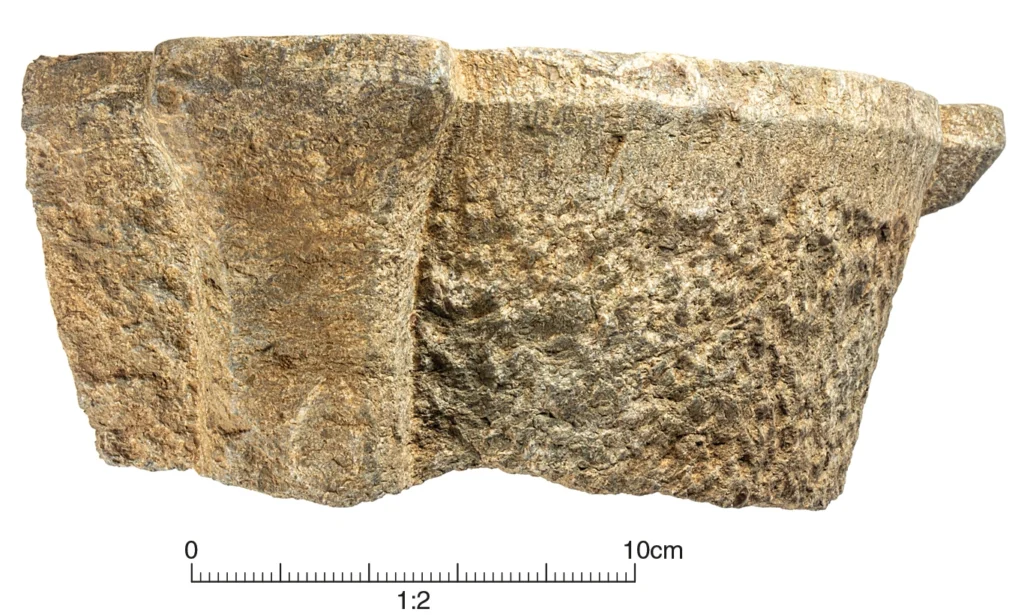
Image: post-excavation study on mortar found at Sizewell C excavations
Household tools
Other finds suggest domestic activities such as spinning and tool maintenance. A small numbers of spindle whorls made of shale and fired clay from the Wetland Habitat Area are suggestive of household-level spinning rather than an industrial or large scale production.
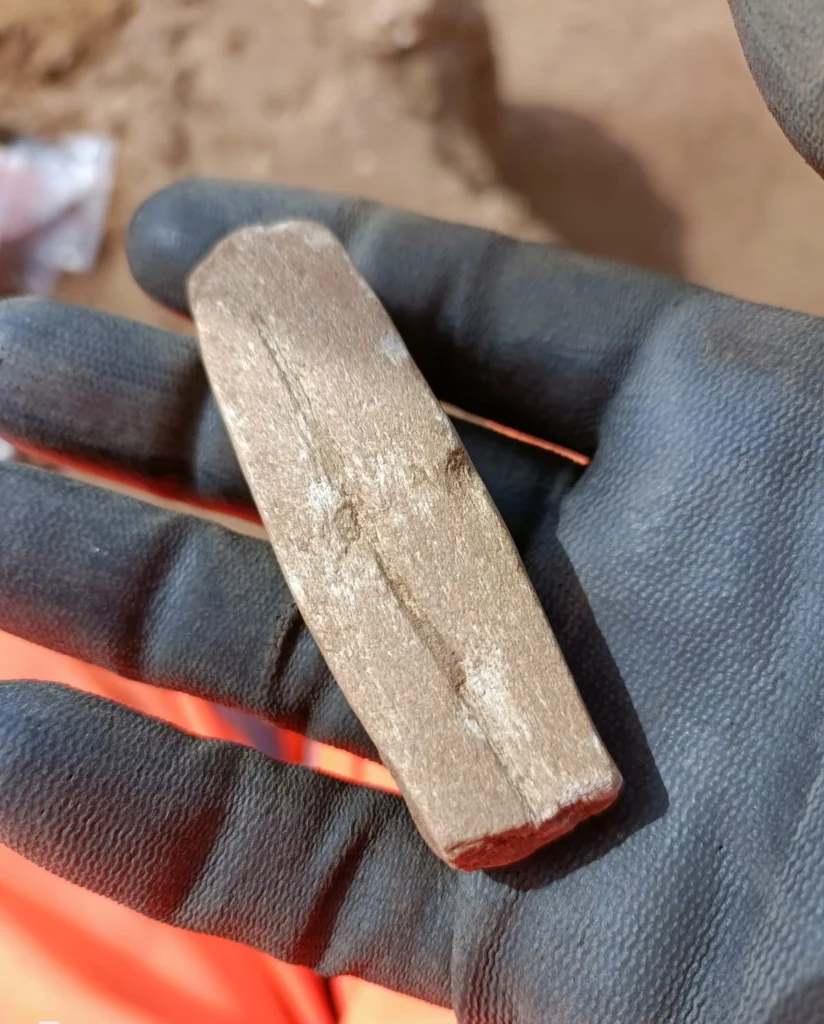
Tool maintenance is evidenced by some whetstones of Eidsborg schist (known colloquially as Norwegian Rag). Despite being imported from Norway, these schist whetstones are very common finds on medieval sites in England, particularly in contexts dating from the 12th – 15th centuries.
Image: whetstone discovered at Sizewell C excavations
Querns and millstones
Finally, let’s not forget querns and millstones. Fragments of Mayen lava have been found on many of the Sizewell C sites. Lava querns and millstones were imported to England from the extensive quarries at Mayen in Germany from the 8th century onwards and during the medieval period, Mayen lava millstones dominated the East Anglian market.
There was a widespread prohibition of domestic grinding from the 12th century, as religious houses controlled cereal grinding on their lands via a mill or mills and, as a result, querns are not common finds on medieval sites. It may therefore be that our fragments are from a mill or mills, rather than from people’s houses. Unfortunately, lava disintegrates in the acidic Suffolk soils so they are uninspiring finds on site, but their recovery and quantification will be useful for helping us understand the distribution and the chronology of lava quern and millstone use in the area.
Although the worked stone from the Sizewell C site is numerically dominated by lava fragments, the other artefacts we’ve found are providing us with insights into the area in the medieval period. Spinning and tool sharpening are typical of household activities and are probably evidence of rural occupation, but the mortar, lamp, and ashlar blocks are strongly suggestive of a higher-status building nearby.
Although none can be certainly said to come from Leiston Abbey, they individually each have possible ecclesiastical connections, which together more strongly suggest a link. If the lava fragments can also be shown to be from millstones rather than querns, then these too would establish that link.