
Heroes on the Home Front: Remnants of the Home Guard’s efforts during WWII found at Sizewell C
Date Written
8 May 2025
Author
Hannah Bullmore (Goose Hill Area Supervisor) and Ed Tolley (Goose Hill Area Lead)
Projects

Today marks the 80th anniversary of VE Day (or Victory in Europe Day), which is the day that Germany surrendered to the Allied Forces in Europe on 8th May 1945. While the war itself wouldn’t be over until August 1945, VE Day was a day of relief and celebration for millions of people, with street parties and celebrations held across the UK. A local child recalled their memories of VE Day, “After exactly 6 years, the strange lifestyle, which I had come to accept as normal, came to an end” highlighting just how momentous and unforgettable the day was.
We know that numerous different regiments of regular soldiers were stationed in and around Sizewell and the nearby town of Leiston during the war (including at an American Army Air Force base at Leiston Airfield). Initially this was to build and maintain coastal defences, but in the later stages of the war these troops were carrying out training exercises in preparation for the invasion of mainland Europe. Our archaeological work on Goose Hill has uncovered numerous traces of this wartime activity. However, these were not the only soldiers active in this part of Suffolk during WWII.

In 1940, the Home Guard, known at the time as the Local Defence Volunteers (LDV), was formed as a volunteer civilian defence force. Many local men who couldn’t join the regular armed services (because they were too old or young, or classified as unfit or ineligible) joined one of the eleven Suffolk Home Guard regiments, tasked with defending the coastline and the surrounding area. In the early part of the war these groups were poorly resourced and sometimes disorganised (think Dad’s Army), but over time they became a vital resource in the war effort.
In this part of Suffolk, after 1943, the Home Guard was responsible for manning the coastal defences while the standing army prepared for the D-Day invasion. The Home Guard was issued with weapons, such as rifles, spigot mortars, sticky bombs, and Sten guns. They also manned anti-aircraft batteries, anti-tank guns, roadblocks, and key strategic points throughout Suffolk. Examples of some of these munitions have been recovered from site during pre-excavation clearances.

The Home Guard in Leiston (the 8th Suffolk Battalion) had its headquarters at the Garrett Works (now the Long Shop Museum), an engineering company famous for manufacturing steam engines and agricultural machinery, where many local people worked and which turned to manufacturing munitions during WWII. It is possible that there is a connection between the Garrett Works and one of the unanswered questions we have about the archaeological remains on Goose Hill.
Image: WWII Home Guard Garrett Works Hall Headquarters in Leiston. Courtesy of the Long Shop Museum
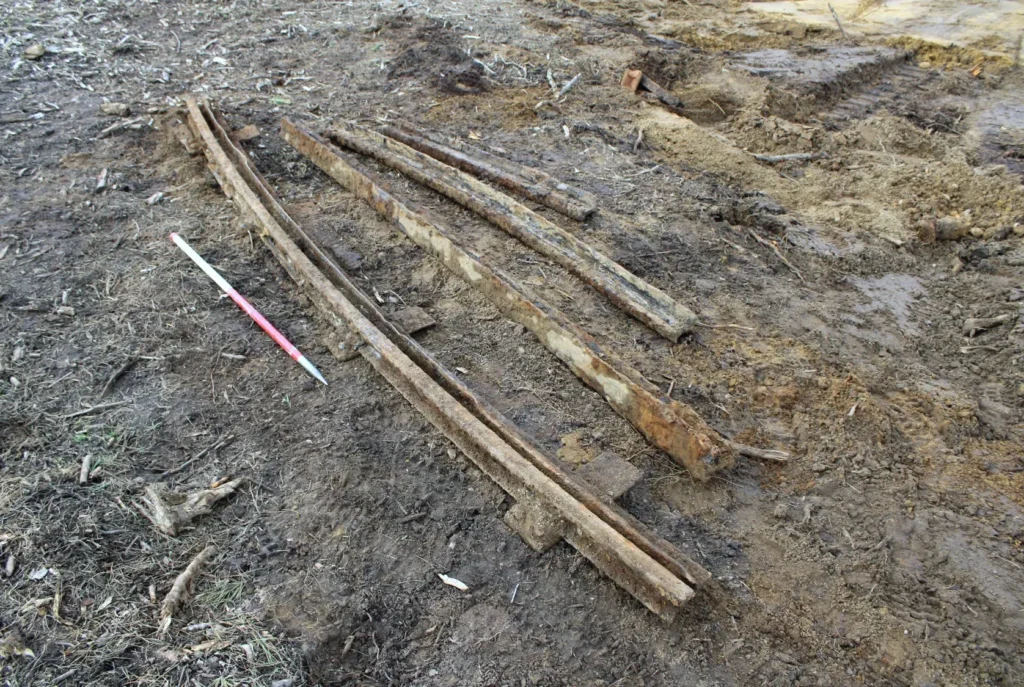
We have found several lengths of single gauge railway track, as well as railway sleepers and possible impressions in the ground from where these sleepers might originally have been set. While we think these may be related to WWII activity, currently we can find no record of a railway in or near Goose Hill on any maps or army records from the period. The main line of the railway ran through Leiston to Aldeburgh, with additional spur lines added by Garrett engineers directly to the Garret Works, and to Sizewell to aid with the construction of anti-aircraft batteries during the war.
Image: lengths of single gauge railway track recovered at Goose Hill
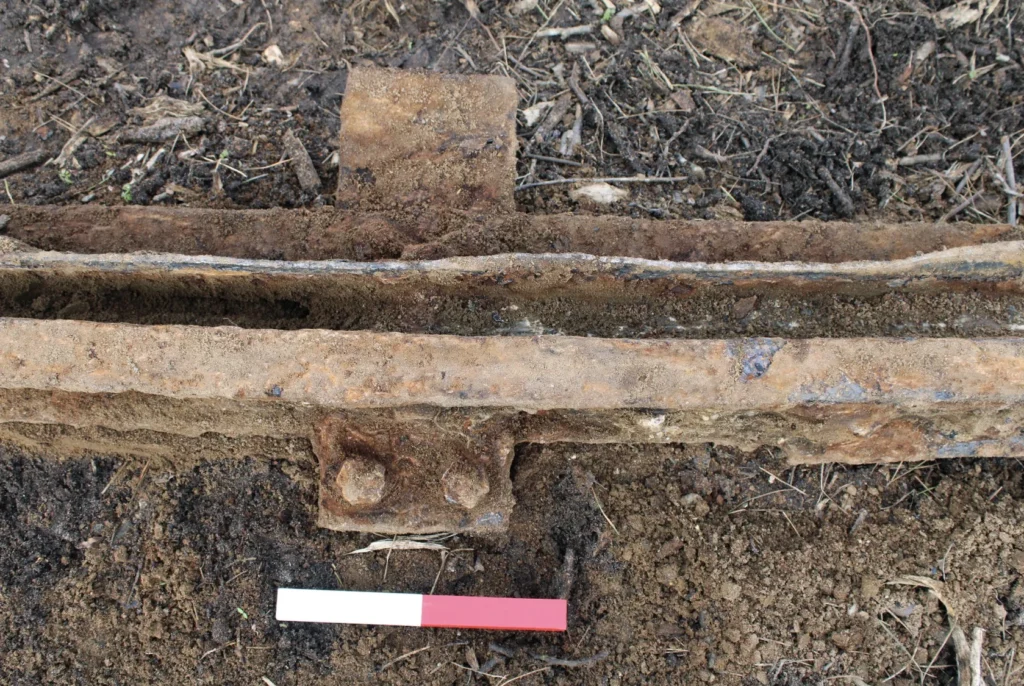
During WWII, an armoured train patrolled the main line as part of the network of coastal defences, and after 1942 this was manned by the Home Guard. But this section of track runs far to the south of our excavations. It may be that our track was used for transporting materials and supplies to the army units building coastal defences or carrying out exercises on Goose Hill, but so far the presence of this possible railway remains a mystery. Was this produced by the Garrett Works? Does it relate to wartime activity?
Image: close-up of a portion of the railway track recovered during excavations at Sizewell C
After the war ended in 1945, some of the coastal defences were actively dismantled, but others were left to collapse and fall into ruin. The army training area on Leiston Common is described as becoming a playground for children after the war, and many pillboxes still remain as local landmarks dotted through the Suffolk countryside. Our work at Goose Hill has been able to uncover some of the less visible remains of wartime activity, adding further detail to our understanding of WWII history along this part of the Suffolk coastline.
You can read more about the local Home Guard by visiting the sites listed below:
- John Daniels – local child during the war, BBC archives (Part 1, Part 2, Part 3)
- Jack Taylor – Home Guard volunteer County Durham, BBC archives
- Long Shop Museum