
A glimpse of Neolithic life at Sizewell C
Date Written
4 June 2025
Author
Alex Davies (Sizewell C Post-Excavation Manager)
Projects

The OCA team at Sizewell C are uncovering extraordinary insights into the Neolithic period, dating back 6,000 to 4,200 years ago. Our dedicated team has unearthed numerous pits that, while seemingly unassuming, hold invaluable clues about the ancient communities that once thrived in this area. These pits provide a unique window into the daily lives and practices of Neolithic people. Join us as we delve into the fascinating discoveries that shed light on our distant past

The hundreds of pits excavated at Sizewell C might seem less impressive than contemporary monuments like long barrows and enclosures, but offer the chance to better understand the daily lives of the people who created them. The finds found within the pits include pottery, worked flint, charcoal, animal bones (where surviving in the acidic sandy soil) and charred hazelnut shells. Most of the pits are circular and bowl-shaped in section (up to 1m diameter and 0.5m deep). The rare larger pits, up to 3m across and 2m deep, might have had a different use.
Based on the objects found within them, these pits are often thought to have been filled with waste from domestic activity, but their use is more complex. They are too small to have been used for storage or to quarry stone or clay. While they contain objects that were clearly produced by normal day-to-day activities, there isn’t enough material to identify them as prehistoric rubbish bins. Therefore, as there is no clear strictly practical explanation for their use, the archaeologists think they might have had special, ritual meaning. It is not very common for the Early Neolithic, but some of the finds seem to have been carefully ‘placed’ in the pits.
One idea is that this material was deposited in a pit at a significant moment in the life of a settlement, perhaps as a way of marking a group’s presence in the landscape. Similar pits have been found at Durrington Walls, a site near Stonehenge where archaeologists think the builders of the most famous stone circle in Britain lived during construction.
Unusually, archaeologists found well-preserved houses there, built on top of pits. When the house was no longer used, a new pit was cut through the floor and then filled with domestic rubbish, very similar to the ones found at Sizewell. Archaeologists believe this was a way of ‘closing’ the house before it was abandoned, almost like a farewell ritual. But Durrington Walls is very unusual because of its association with Stonehenge, and it was built over 1,000 years after the Sizewell pits. So, the similarities are very interesting, but also raise a lot of questions.
A much simpler possibility is that these pits were latrines (toilets) that were filled with the surrounding rubbish when the settlement was abandoned. As the pits often appear in pairs or small groups, it is possible that a new latrine pit may have been dug in the same area (being careful not to dig into the old one!) when settlements were seasonally reoccupied. To test this theory, archaeologists plan to study the soil closely. If these pits were used as latrines, there might still be tiny traces left behind in the dirt that can give us the answer.
But at Sizewell there are also half a dozen much larger pits, and these might have been used for storage. These large pits are very rare nationally, so the number is very significant. It is possible that these are grain storage pits.
Image: One of the unusual larger pits
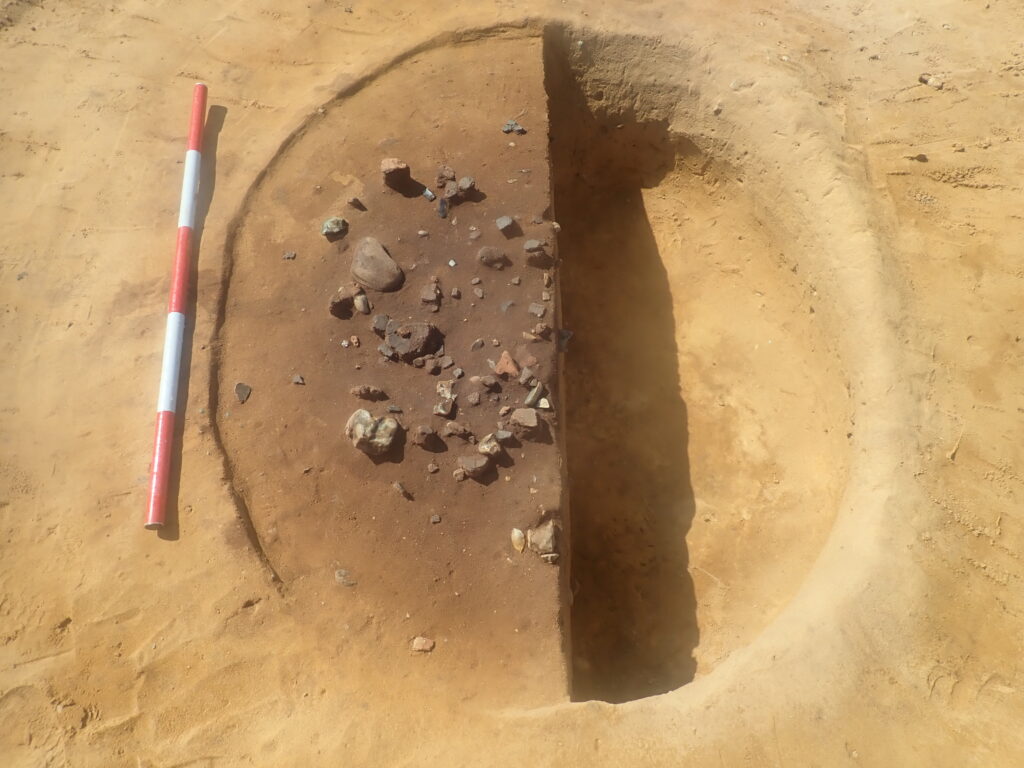
Grain storage pits are more associated with the Iron Age, and experimental work shows these large pits, with vertical sides and flat bottoms, are much more suited to store grain than the small bowl-shaped pits that are much more common. The finds from these pits give important clues: a quern stone (a simple tool used to turn grains into flour) was found in one of the large pits, while a complete, large upside-down pot was found in the base of another. The pot may have been placed over something, perhaps some grain or other food, to store it, but was never retrieved.
At Sizewell the pits occur singularly, in pairs, as small groups, or as larger concentrations. It is likely that this also has significance. Do larger groups of pits indicate a large settlement, or one that lasted for a longer period of time, or both? In one of the areas, around 300 Early Neolithic pits were recorded — something that is of regional significance. This has parallels elsewhere in East Anglia, for example, at Kilverstone and Hurst Fen, but such large groups are unknown elsewhere in the country.

Curiously, the region east of the Fens (in East Anglia) has very few known causewayed enclosure monuments, which are likely to have been meeting places for dispersed Neolithic populations, a focus for ceremony, exchange and festivities. Perhaps the large East Anglian pit groups were also gathering places, but without monuments.
The construction of Sizewell C presents the opportunity to explore these interpretations and come up with new ones across the landscape. By comparing the different sites where evidence for the Early Neolithic has been found, archaeologists hope to be able to find a greater understanding. For instance, were different forms of flint working undertaken in different places? Or does the decorated pottery found in some locations indicate individuals or sites of greater status? And environmental remains (like those charred hazelnut shells) may give clues about what times of year the sites were occupied, as well as offering material from which radiocarbon dates can be obtained, to tell us how long each site was occupied and which sites were contemporary.