Although often small and easily overlooked, fragments of worked stone can provide archaeologists with remarkable insights into prehistoric life.
Along the A66 Northern Trans-Pennine project, excavations have uncovered several lithic scatters — concentrations of worked stone — which reveal how people once moved through, used, and returned to this landscape thousands of years ago.
In this blog, site supervisor Indigo Ridgewell and specialist Antony Dickson explain how archaeologists excavate and record these subtle remains, and what they can tell us about prehistoric activity across the A66 landscape.
Why Were Stone Tools Important?
When we think of tools, we often think of objects made from metal. However, for many thousands of years before metalworking developed in Britain during the Bronze Age (c. 2500 BC), stone was one of the most important materials available to prehistoric communities. Stone tools played a vital role in helping people survive and adapt to their environments and were used for a wide range of tasks including hunting animals, butchering meat, preparing food, woodworking, and processing hides.
Over thousands of years, stone tool technology developed and became more refined, reflecting changing lifestyles, environments, skills, and cultural practices. Because of this, stone tools are some of the most important archaeological evidence for understanding prehistoric human activity.
The term prehistory refers to the period before the development of written language, which is why periods of prehistory vary widely depending on where you are in the world. For example, in Ancient Egypt the prehistoric period ended in c. 3000 BC, significantly earlier than here in Cumbria. In Britain, prehistory generally refers to the period of human history before the Roman occupation in AD 43. This spans roughly 10,000 years, from the Late Upper Palaeolithic to the Late Iron Age.
The earliest stone tools found so far along the A66 were dated to the year 12,700 cal BC(Late Upper Palaeolithic period) .
What evidence do we see in the archaeological record?
Stone tools are often the only evidence archaeologists find for early prehistoric settlements, which makes them important for understanding the archaeological record.
Types of stone tools
Archaeologists recover a wide range of evidence relating to prehistoric stone tool use and manufacture. This includes tools such as knives for cutting, scrapers for processing hides, axes for felling trees and woodwork, blades for a variety of everyday tasks, and arrowheads used for hunting.
In Mesolithic sites, archaeologists often find microliths; small, carefully shaped flint blades that were attached to bone or wooden handles and used for tools or hunting.
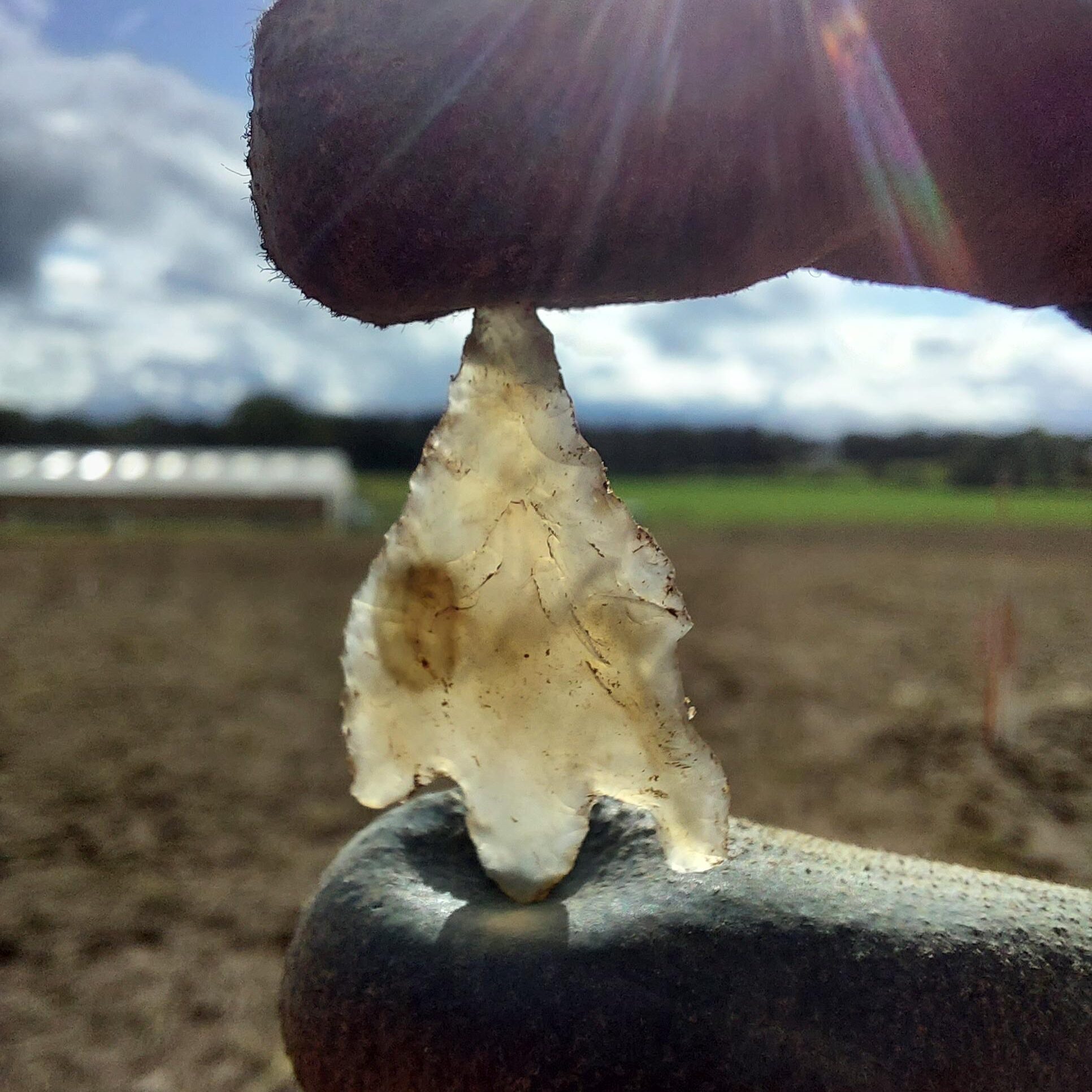
Image (right): example of a early Bronze Age barbed and tanged arrowhead used for hunting found in 2025 during fieldwalking on the A66 excavations
What is knapping?
Waste material created during tool creation (the process known as ‘knapping’) is often found in the form of scatters of broken stone flakes called debitage – the products removed from a stone core as it is struck using a stone or antler. These products, are referred to as flakes and blades (see images below), and were sometimes used as tools in their own right or modified again with further knapping.
When concentrations of cores, debitage and tools are found together, archaeologists refer to these as lithic scatters. These scatters can represent places where tools were made, repaired, or used thousands of years ago.
Stone Core: the parent raw material often in the form of a stone nodule that is quarried or collected.
Flint coreSmall flint scraperFlint bladelet
Images (above): variety of types of stone tool evidence found within archaeological contexts
Lithic scatters on the A66
Archaeologists working on the A66 have identified several lithic scatters across the scheme. Excavating lithic scatters requires a particularly careful method. Even the smallest fragment of worked stone can provide important evidence about prehistoric behaviour, tool production, or the date of activity on a site.
Indigo explains:
“When we excavate a lithic scatter, it is important that we understand when it dates from, how the finds relate to one another, how the layers they are found in were formed and how the finds are spread across the site. This requires a careful and detailed method that helps us answer these questions and others that might become relevant.”
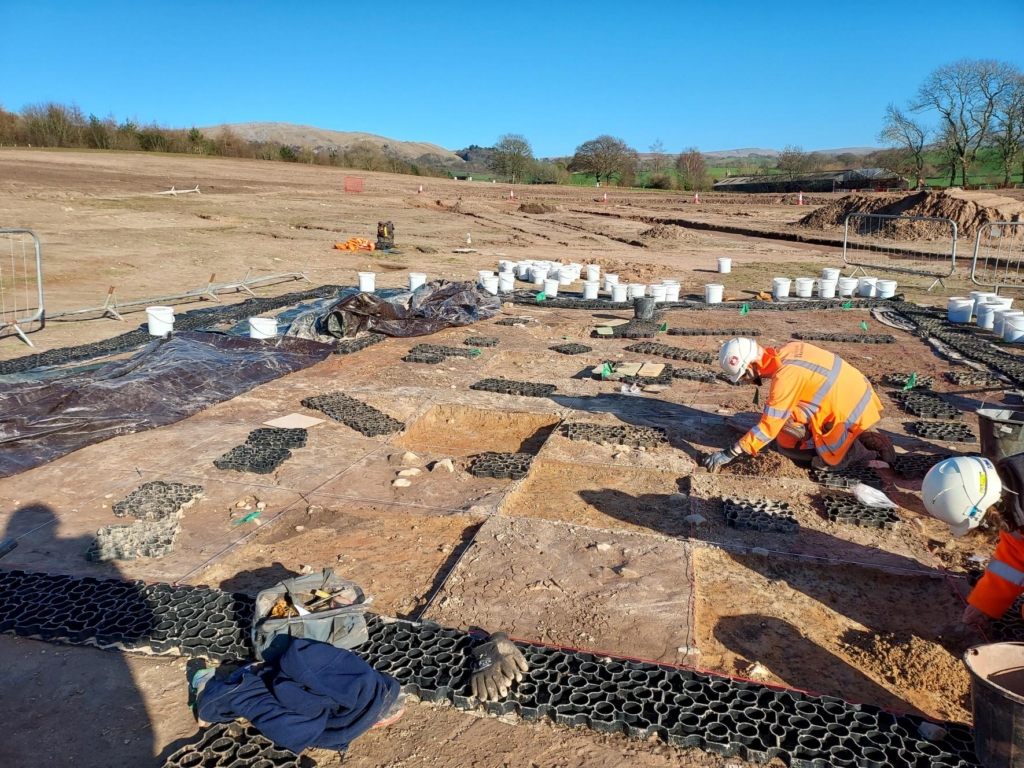
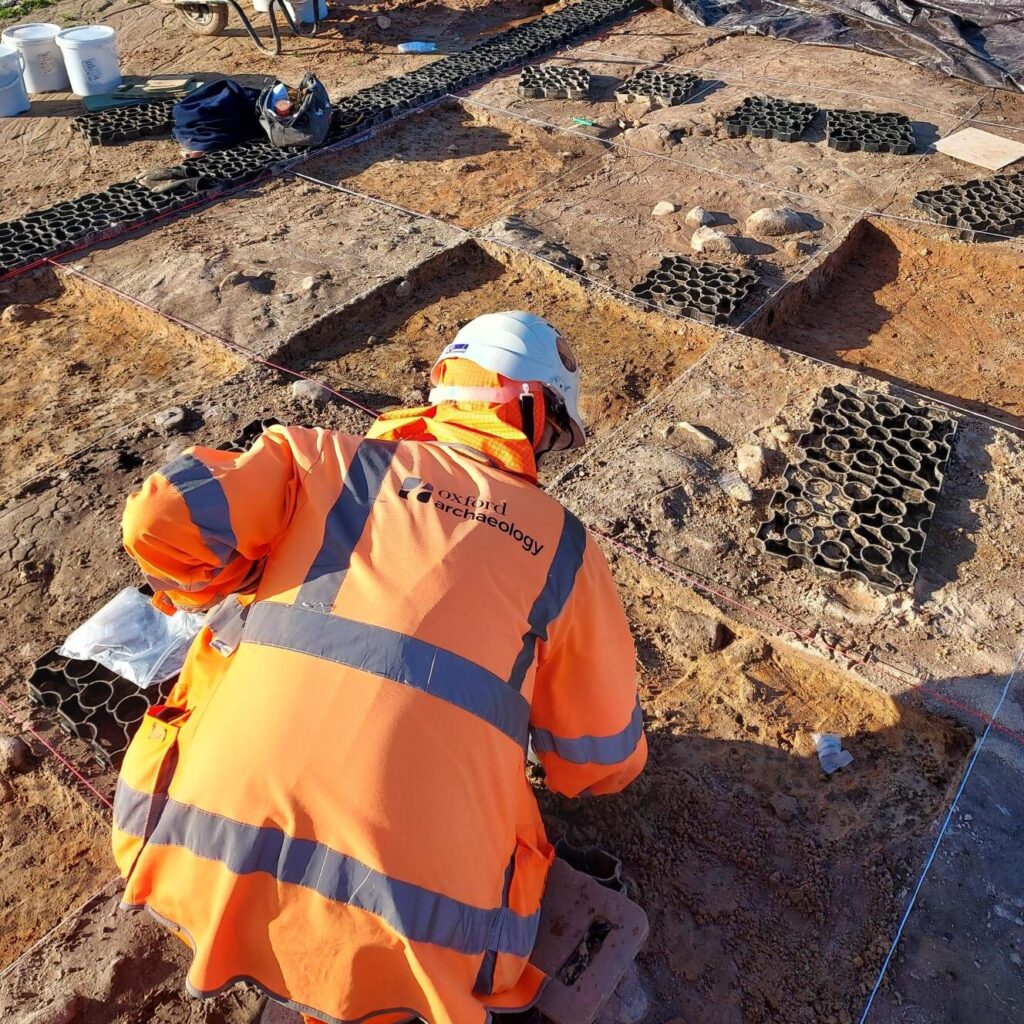
Image: archaeologistsexcavating flint scatter near Warcop
So how do we excavate one?
Unlike larger archaeological features such as pits, ditches or walls, lithic scatters (as the name suggests) can be subtle and dispersed across wide areas.
Antony explains:
“The first step when excavating a lithic scatter is to define its full extent and characterise it using test pits. Next, we set out a grid over the lithic scatter and give each square its own number. From then, we carefully excavate each grid square in thin layers (called spits). These spits are usually 5cm thick.We excavate layer by layer (stratigraphically) and record the exact 3D location of each piece of worked stone larger than 10mm. Throughout this process, we also collect samples for prehistoric plant remains, soil micromorphology analysis and OSL dating through the sediment sequence.”
Image: overview of initial test pits in a lithic scatter
Image: grid square of lithic scatter layer with bagged lithics found within
Excavating using a grid system allows for archaeologists to record finds accurately.
Indigo Says:
“We usually excavate the grid in a chequerboard pattern (see above image). This helps us to understand the context of the scatter, preserve information such as depth of each layer, and also identify any changes across the site.”
Excavating Layer by Layer
Excavating stratigraphically means removing layers of soil in the reverse order that they were formed. This helps archaeologists understand which artefacts are older and which are newer. By understanding which artefacts come from which layers, archaeologists can identify activity from different prehistoric periods within the same area.
Antony highlights:
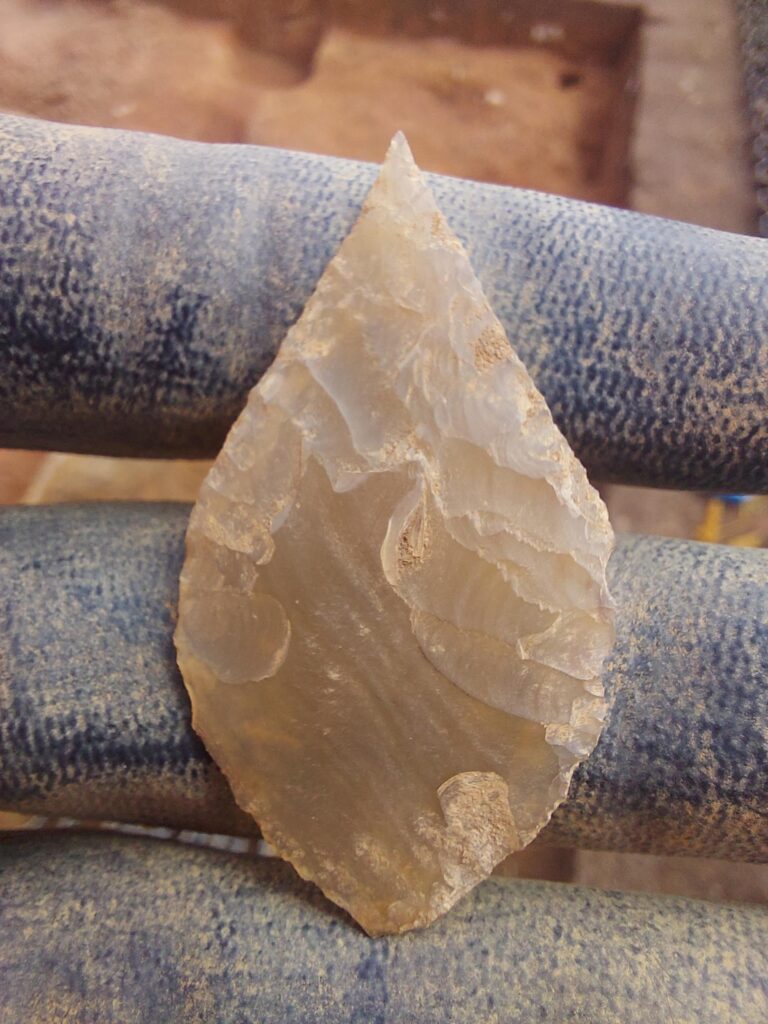
“It’s important to identify stratigraphic sequences as sometimes site locations become the focus for visits spread over different periods. For example, the careful excavation of one lithic scatter revealed a sediment layer containing an Early Neolithic leaf-shaped arrowhead and other lithic artefacts which stratigraphically overlay earlier, Mesolithic lithics. This suggests that the site remained important during the transition from one period to the other.”
Image (top right): Early Neolithic leaf-shaped arrowhead
What do lithic scatters tell us?
Although lithic scatters are made up of small fragments of stone, they can provide remarkably detailed insights into prehistoric life.
Understanding Tool Making
By studying the collection of knapping debris from a scatter, specialists can learn whether the site was used during one prehistoric period or across several different periods. They can also learn which stages of tool making took place there.
Some sites contain evidence for the complete process of tool production, while others may have been used only for specific tasks. Specialists also look for evidence such as cores, blades, flakes, micro-debitage, and retouched tools to understand how tools were being made. If only certain parts of the tool-making process are recorded, it might suggest the site was used for a specific specialised activity.
Image (right): archaeologists Indigo Ridgwell with early Neolithic polished stone axe
The two late Mesolithic scatters excavated on the A66 at Warcop and Brough had around 1000 lithics each, including cores and debitage. The evidence found suggests small, short stay camps that will have constantly moved along the Eden Valley landscape. This reflects how smaller hunter gatherer bands moved around the landscape making use of resources available.
In contrast, a nearby late Mesolithic scatter at Stainton West, near Carlisle in Northern Cumbria, comprised a total of 300,000 lithics, including cores, debitage and over 6000 microliths. The large number of lithics and evidence for structures points to substantial site used as a meeting place for communities and family groups.
Where Did the Stone Come From?
Specialists can also identify the types of stone being used and, in some cases, where the raw materials originally came from. This helps archaeologists explore patterns of movement and contact between groups working stone from the same source, potential trade, and landscape use during prehistory. Did certain groups of people prefer certain stones for tool making? Are certain raw materials worked in a specific way compared to others? These are all questions future research may help to answer.
Image: archaeologist excavating grid square
Analysis of the Stainton West Late Mesolithic Scatter assemblage determined raw materials used came from as far as the Southern Scottish Uplands and eastern side of the Pennines. Initial analysis of the A66 flint scatters also points to raw materials from further a field such as Scottish chert and Yorkshire flint.
Image: map showing raw material distribution from Stainton West, Carlisle
Reconstructing Prehistoric Activity
We can also recreate past tool making activity from where each piece of worked stone was found. Different daily tasks, that involve stone tools, can leave behind distinct patterns of stone fragments. This information can help archaeologists understand what kinds of tools were being made and how settlements may have been organised.
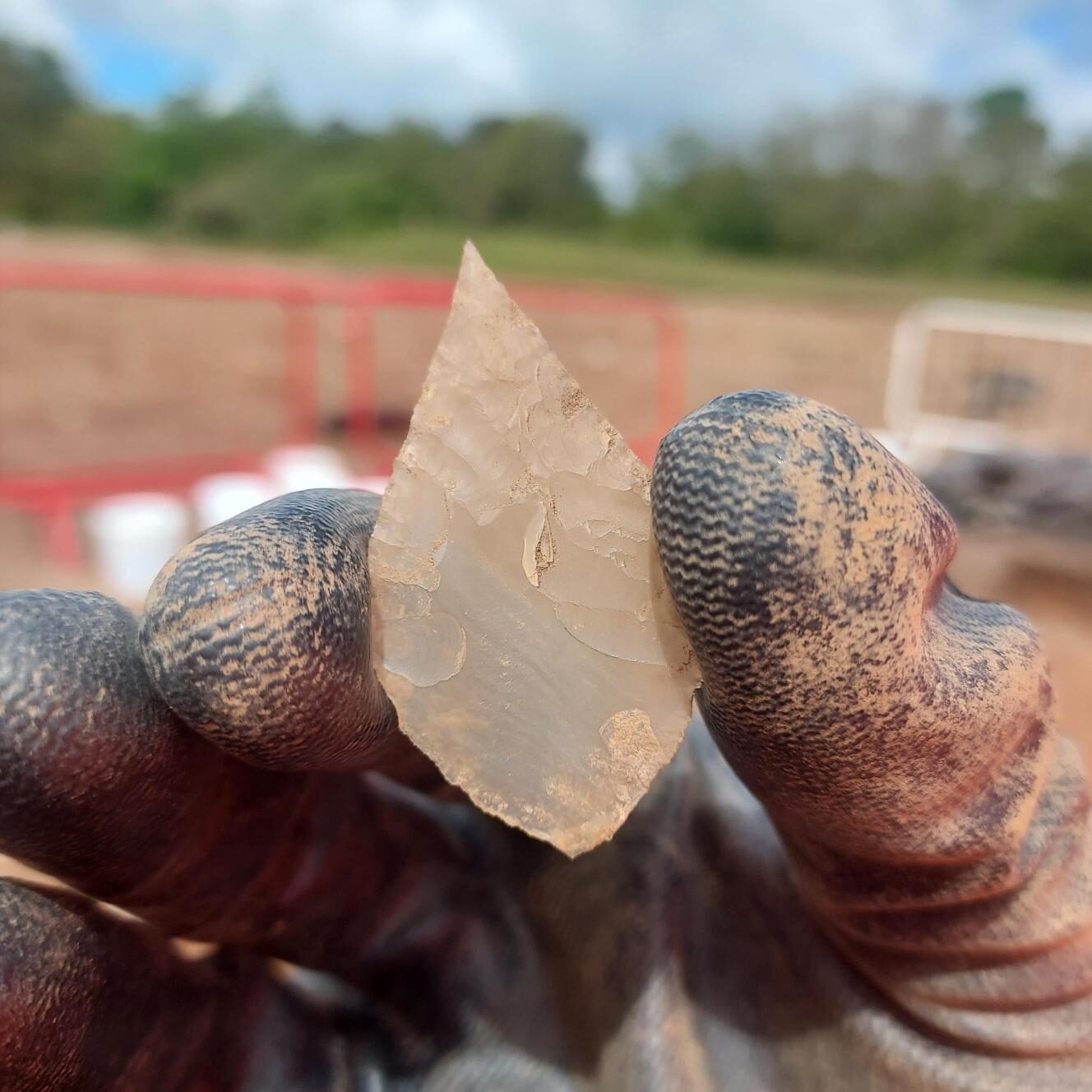
Image (right): archaeologist James Schofield holding leaf-shaped arrowhead from lithic scatter
The site at Stainton West was located on an island on the flood plain of the river Eden ideally located to exploit Atlantic Salmon as they returned to their spawning grounds upriver. With that in mind, it is likely that Stainton West acted as an important meeting place for the wider region, with groups coming from far away to exploit this seasonal phenomenon.
The A66 lithic scatters were located adjacent to wetlands which would have provided a range of resources. It is possible that both sites represent small groups whose lives were intertwined with large scale gatherings such as that at Carlisle.
By combining excavation, recording, and specialist analysis, archaeologists can transform seemingly scattered fragments of stone into evidence for how people lived, travelled, and interacted with the landscape thousands of years ago.
Indigo comments:
“It is great to see the team get so excited, especially when they find something like a leaf-shaped arrowhead. It is cool to see them learn how to identify different tools and the sometimes very slight differences between materials. It takes a keen eye to spot these differences, and it is so rewarding to see their skills develop.”
Image (left): Archaeologist holding flint scraper
The lithic scatters uncovered along the A66 continue to provide important clues about prehistoric life, helping archaeologists piece together the stories of the people who once travelled through this landscape.