
Shining a light on Neolithic rock crystals: new clues from the A66
Date Written
16 April 2026

Quartz is everywhere across the UK – common, familiar and often overlooked. But one rare variety, rock crystal, tells a different story.
Archaeologists have found it at a small number of Neolithic sites in the UK and Ireland. Wherever it appears, it sparks the same question: why were people so keen to collect, shape and bury this unusual and rare material?
Prehistoric expert Nick Overton shares what new discoveries from the A66 may reveal.
What is rock crystal?
Quartz is one of the most common minerals found across the UK. It appears almost everywhere, in many different shapes, sizes and forms. You can find it in tiny grains of sand, milky beach cobbles and white veins in rock formations. So why are archaeologists so interested in something that is so ordinary?
The answer is quite simple: rock crystal is very different to the other types of quartz we might see in our day-to-day lives.
Rock crystal is found as transparent ‘water-clear’ crystals. They form under very specific conditions, inside what geologists call Alpine-type fissures. These are cracks that run through layers of rock, which are created by movements in the earth’s crust. Hot water and gases flow through these fissures. They create the exact conditions needed for pure quartz crystals to grow.
In Britain, there are only a handful of known sources where high-quality and large (over 5cm long) crystals have been found. These are in Cornwall, Wales (particularly Snowdonia) and parts of Scotland (see map below).
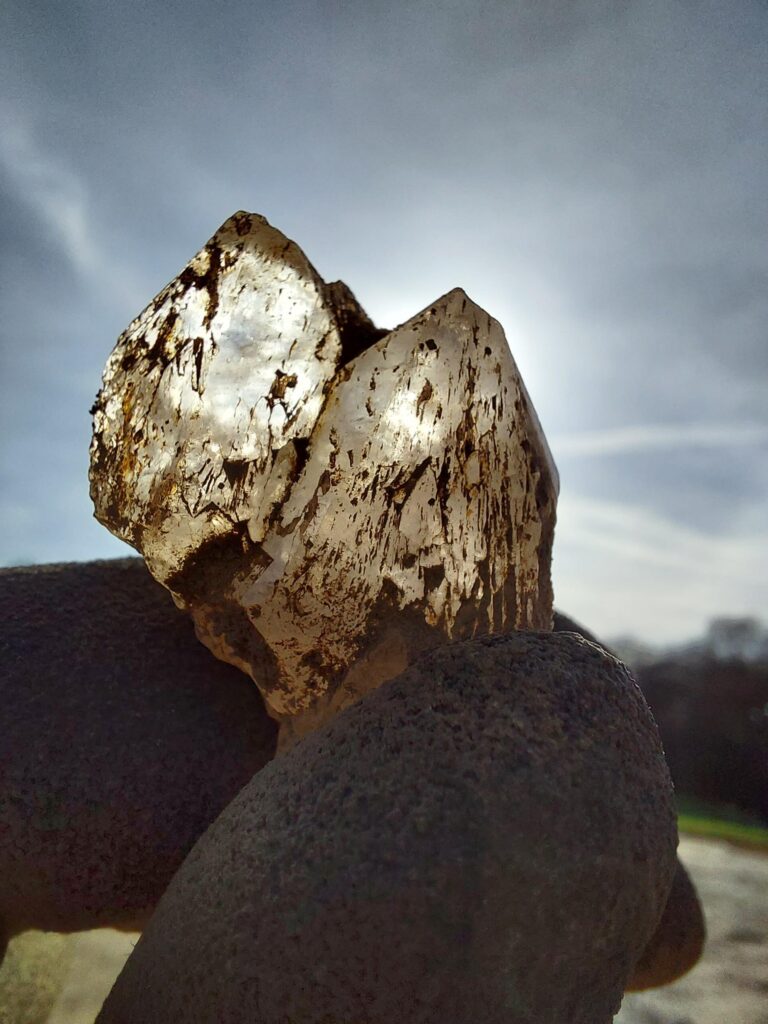
Image: archaeologist holding a piece of transparent rock crystal
A rare material in prehistory
In prehistory, people used a variety of materials to make stone tools. This includes materials such flint, chert and even white quartz. However, because of its scarcity, rock crystal is rarely found on archaeological sites. In the UK and Ireland, around 40 sites show signs of people gathering, keeping and working rock crystal (called knapping) (see map below). Of these, the majority (25 sites) date to the Neolithic period (4000-2400 cal BC).
Knapping: is a method of chipping/striking stone, usually shaping stone into a tool or weapon.
Nick Overton explains:
“These sites mainly cluster along the western coast of Wales, England and Scotland, and in Ireland. The Irish sea is a key focus. Sites are located along this coast, like those on Anglesey. Others are in inland locations, near rivers that lead to the west coast. This pattern hints at possible connections between communities around and across the Irish sea.”
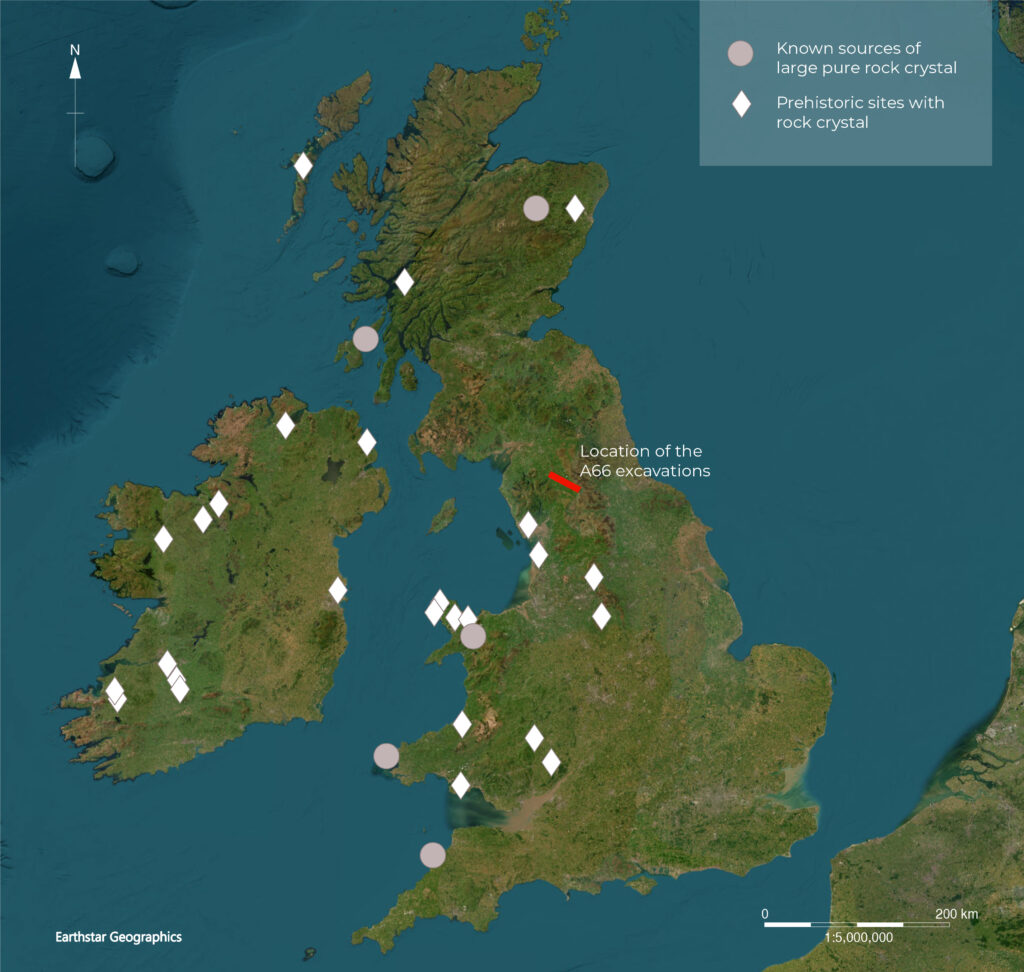
Image: map showing the distribution of known rock crystal sources and location of prehistoric sites where they have been previously found
Archaeologists have found large, pure crystals at many of these sites. However, these locations are a long way away from any known source. An assemblage of hundreds of pure rock crystal pieces was found at Dorstone Hill, in Herefordshire. This site is at least 80-100km away from the closest known source. This shows that this material travelled long distances from its source, either carried, traded or exchanged by people, which suggests it was valued by Neolithic communities.
Nick Overton says:
“We seem to be finding rock crystal at certain types of Neolithic site, which suggests people viewed it in a particular way. Several sites are associated with the burial of the dead, including cremated bone. We also find it at larger timber halls/structures that date to the very early Neolithic (4000-3800 cal BC) and may have been important gathering places for new communities that were forming at this time in the UK and Ireland.”
The rarity and exotic character of rock crystal may have made it a particularly valuable material to trade and exchange when communities came together at monuments, perhaps as symbols of the distant places they originated from. Equally, rock crystal would have been visually distinctive. In a time before glass it would have been the only see-through solid material. This may have made it seem special, even magical. Instead of being everyday items and tools, rock crystal would have been full of visually dramatic symbolic significance”.
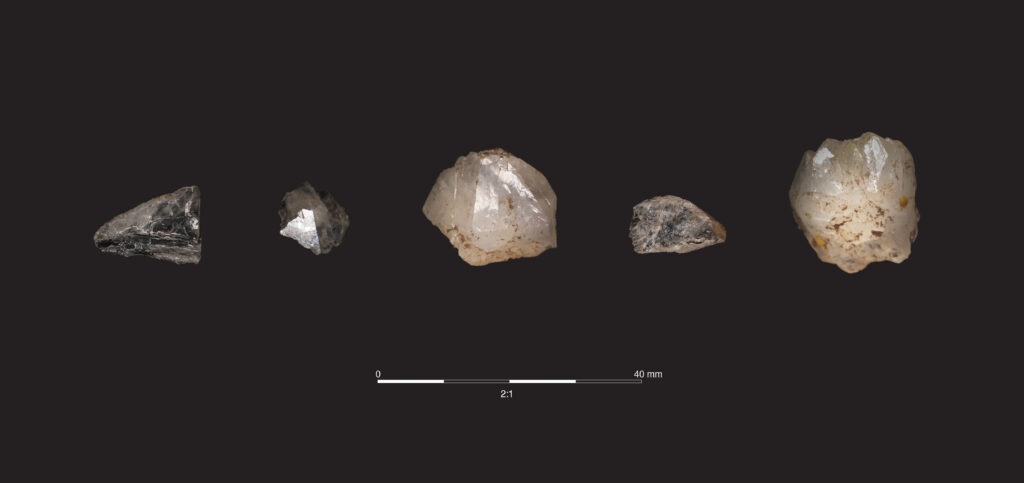
Image: rock crystal fragments from A66 sites
Rock crystals on the A66
Recent excavations for the A66 upgrade have found large amounts of rock crystal. Full analysis still needs to be undertaken, but this could be one of the largest collections of rock crystal ever found on a prehistoric site in the UK. What is particularly interesting is that the material that has been recovered from the A66 includes different qualities of rock crystal. As Nick Overton puts it:
“Some of the crystal is fully transparent, but other pieces are cloudy or translucent. Some of the pieces appear to have been knapped from larger crystals, but there are also very short, squat crystals. One explanation for this could be that the high-quality material is from more faraway places, and the lower quality material is from a local source. The shape of the short crystals is very similar to the character of known quartz crystals found in Cumbria. If this is the case, this shows Neolithic communities along the A66 were connected to a range of local and long-distance trade networks.”
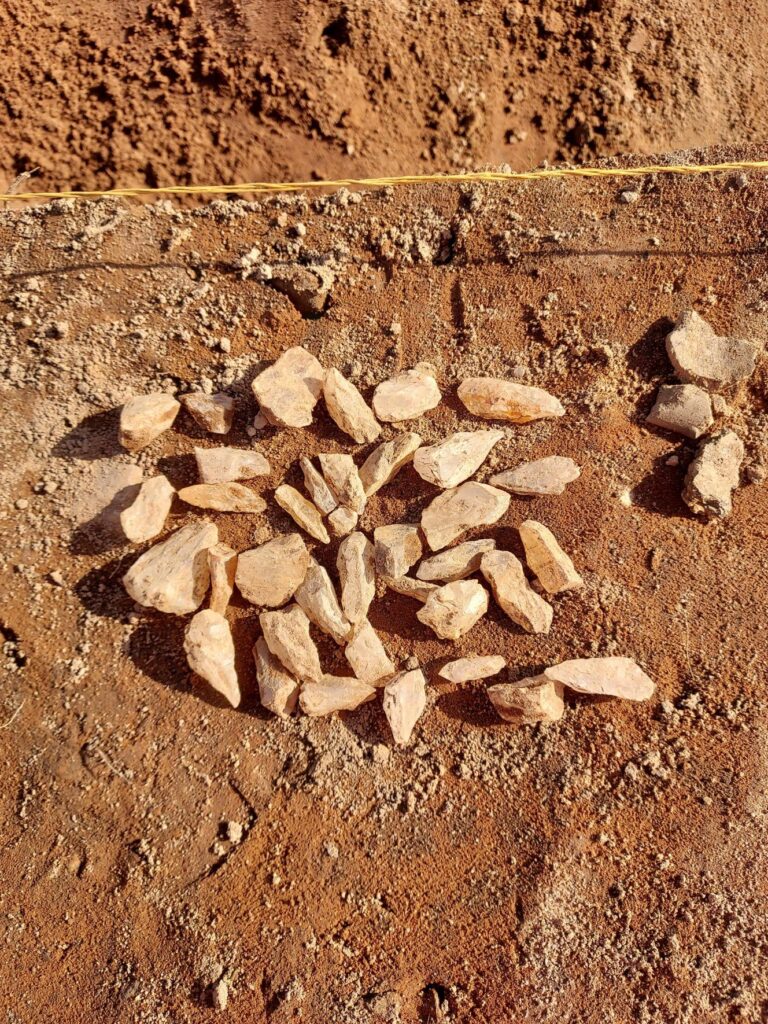
Image: collection of rock crystal found within Neolithic feature
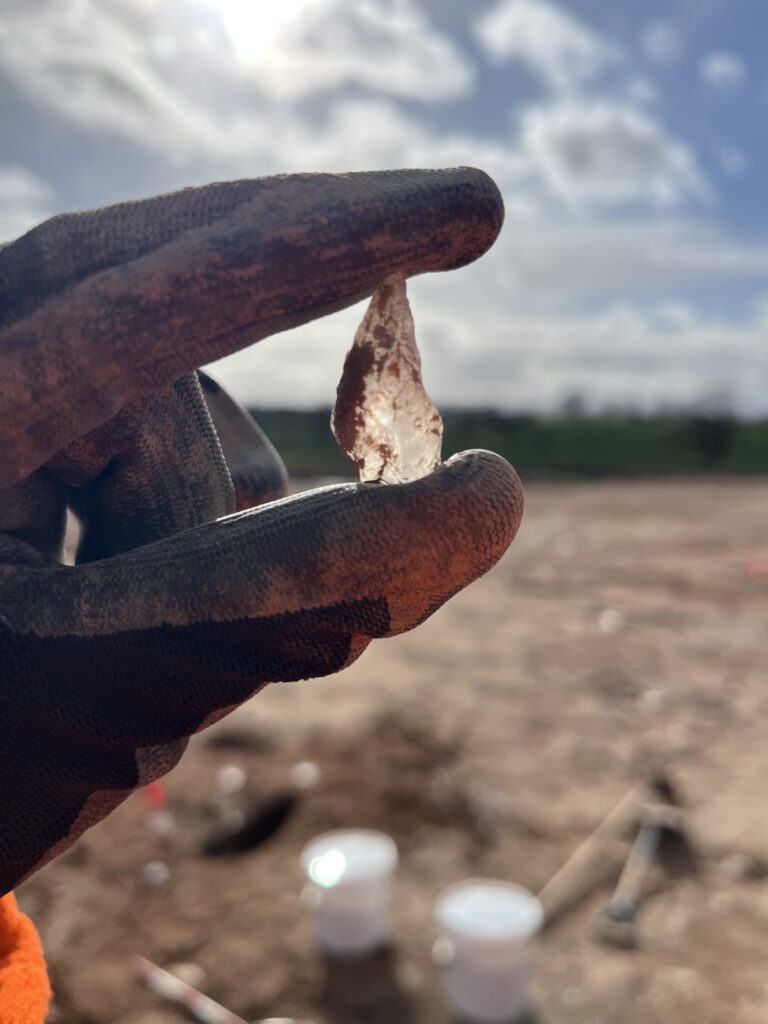
Image: Archaeologist holding piece of rock crystal
The short crystals from the A66, which may be from local sources, seem to have had their tips struck off on purpose, as a way of testing them. As Nick notes;
“The tips of the crystals may have been removed to check the quality of the crystal before they tried to work it further. In many cases, these shorter crystals are lower quality – they are cloudy – and have internal fractures that makes them unsuitable for knapping. The fact that we have recovered a number of lower quality crystals with just their tips struck off suggest people avoided these lower quality crystals.
Neolithic people were not knapping these smaller crystals any further, but large numbers were found deposited in pits. So even though they may not have been suitable for knapping, they were still collected and deposited with care. Neolithic communities saw these crystals as a special material, regardless of whether it was pure enough to knap or not”.
Rock crystal has been recovered from several pit groups and postholes along the A66 excavations, but it is not yet clear what sorts of activities they relate to. Nick adds;
“It is tempting to think that these pits and postholes might be part of timber structures, like those seen on other Early Neolithic sites with rock crystal. But, to date, none of these structures have been identified in the north-west of England, and it might be the case that Neolithic communities in this region just didn’t build them. Oxford Archaeology’s’ recent excavations at Windy Harbour in Lancashire, found Early Neolithic rock crystal, but no timber hall/structure. It is exciting to think that what is being excavated along the A66 right now is going to help us understand the local traditions of Early Neolithic communities in this area, and how these were both similar and different to other parts of UK and Ireland”.
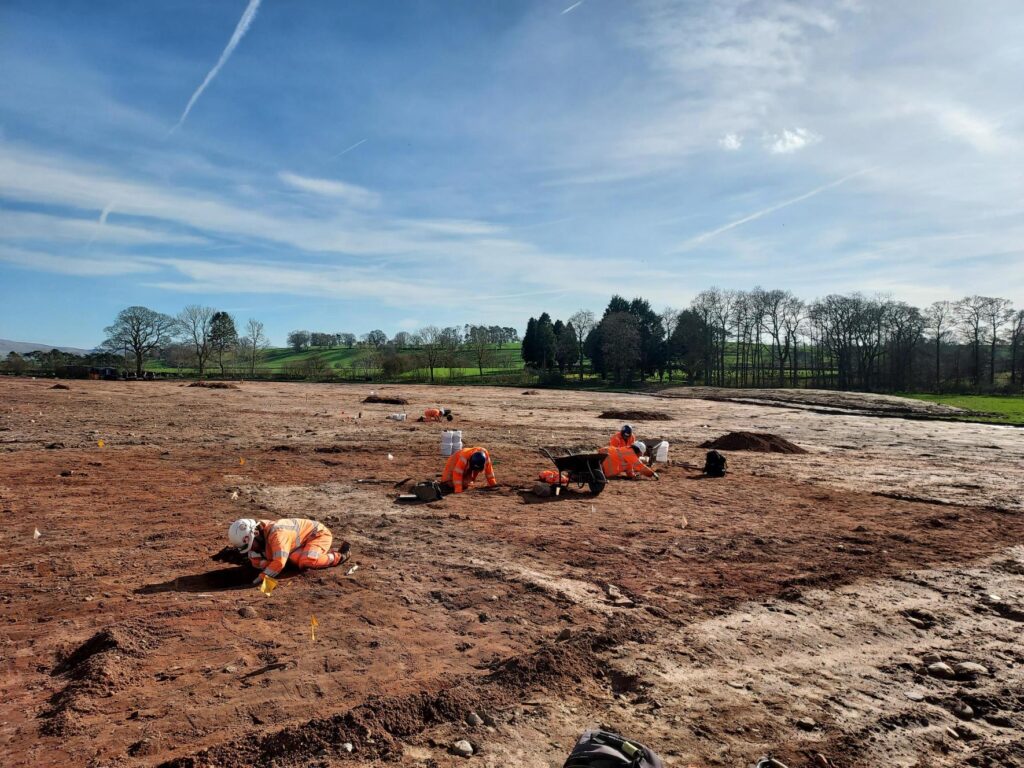
Image: archaeologists on A66 site excavating prehistoric features
Could this natural path through the Eden Valley have helped transport materials like rock crystal from the Irish Sea to a range of different Early Neolithic communities? These excavations are showing that far from being just a single site, the A66 is part of a larger network of movement, exchange, and interaction in the Neolithic world.