
Medieval pots from Bristol
Date Written
3 January 2022
Author
Alejandra Gutiérrez (Senior Finds Officer)
Projects

In 2017 and 2018, Oxford Cotswold Archaeology undertook excavations ahead of redevelopment at Redcliff Quarter in Bristol. Almost 21,000 sherds of pottery (405kg) were recovered. The pottery was first recorded by Finds specialists Ed McSloy and Jacky Sommerville, and has been finely drawn by Illustrator Li Sou. Analysis for publication is being completed by another of our Finds specialists, Alejandra Gutiérrez, and here are some of her favourite pots from the Redcliff Quarter site.

Among the pottery assemblage are fragments from many jugs, one of the basic wares used in medieval households across England. Such vessels were utilitarian objects, used to serve ale or wine at the table, with examples decorated with human faces popular across the country and beyond. They generally represent bearded (male) faces and were placed around the rim of the jug. The beards are intriguing because, although shaving was common right across medieval Europe, facial hair represented manhood and might also have served as a social marker to express belonging to particular social or religious groups. The Christian Church insisted on clerical shaving, so monks and clerics were one social group that was easily recognisable through their hairless faces; as beards represented virility, a close-shaved faced could be seen as a sign of celibacy. At least eight different face jugs were found during the excavation and half of them are decorated with the same hairless face; perhaps even modelled on a real person!
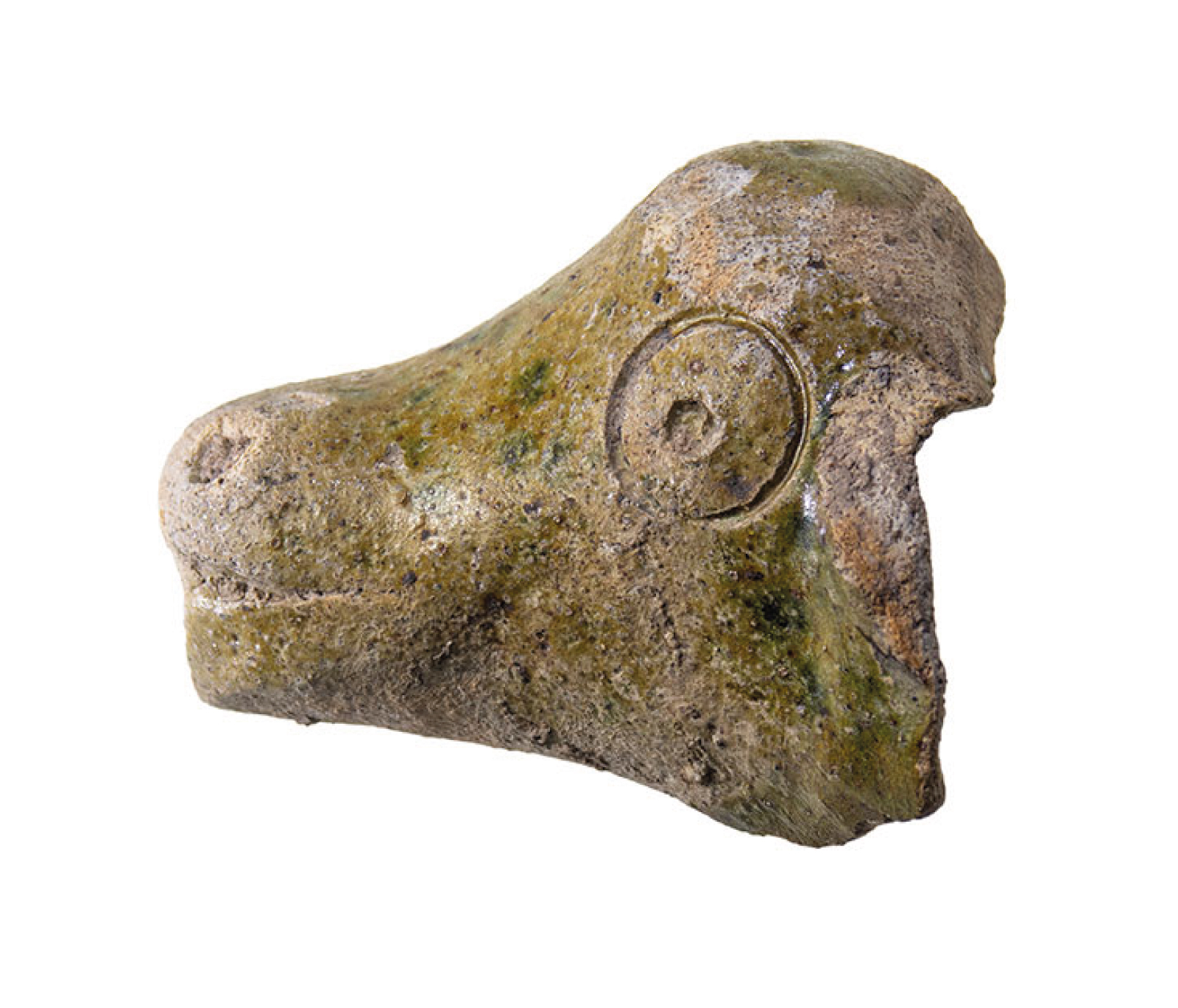
Zoomorphic jugs decorated with animal heads were also recovered during the excavations. In this case, the mouth of the animal served as a pouring spout. Some of these were of local manufacture but other vessels were imported from as far away as London. Conviviality must have been important; a drink shared with a good sense of humour must have tasted better!
Besides basic tablewares and cooking pots, the inhabitants of Redcliff were also concerned with lighting their homes. Candleholders and lamps in a range of materials, including metal and stone, would have been in daily use. Local potters also made them in clay, although they are not frequently found in archaeological deposits. Redcliff Quarter produced a complete oil lamp of surprisingly small size: at only 4.5cm in diameter and about 2cm deep, the upper dish would have held the oil and the floating wick. A tiny handle on the side allowed the light to be carried more easily from room to room without burning the fingers.
